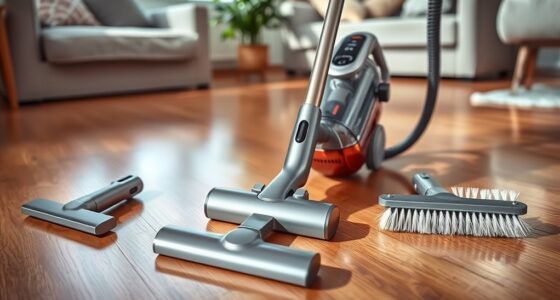
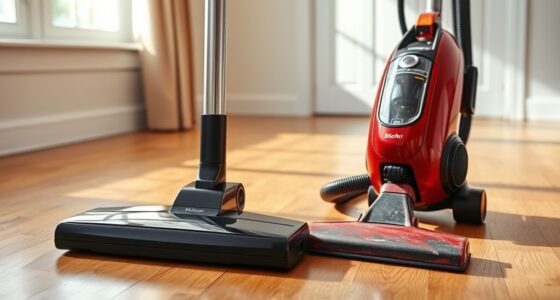
Commercial vacuums are built for heavy-duty cleaning of large, high-traffic areas, offering powerful motors, greater durability, and better efficiency. They tend to be noisier and less maneuverable, making them less ideal for casual or home use. Residential vacuums focus on quieter operation, ease of handling, and convenience for everyday chores. Understanding these differences helps you choose the right vacuum for your needs—exploring further will reveal which fits your specific space and lifestyle best.
Key Takeaways
- Commercial vacuums provide higher cleaning efficiency with powerful motors for large spaces, while residential models are designed for convenience in smaller areas.
- They tend to be louder due to stronger motors, whereas residential vacuums are quieter for noise-sensitive environments.
- Commercial vacuums are larger and less maneuverable, focusing on durability, while residential vacuums are lightweight and easier to handle.
- Commercial models are ideal for high-traffic, heavy-duty cleaning, whereas residential vacuums suit daily home cleaning tasks.
- Commercial vacuums often come with specialized attachments and noise reduction features, unlike most residential models.

Are you wondering whether a commercial or residential vacuum is the right choice for your cleaning needs? When making this decision, you’ll want to contemplate how each type impacts cleaning efficiency and noise levels. Commercial vacuums are built for heavy-duty tasks, so they typically offer superior cleaning efficiency, especially in large spaces or high-traffic areas. Their powerful motors and advanced filtration systems enable you to pick up more debris in less time, making them ideal if you need thorough cleaning without multiple passes. On the other hand, residential vacuums are designed with convenience and comfort in mind. They usually excel at cleaning smaller, more delicate spaces with less effort, but may not match the raw power of commercial models. If your home has a lot of carpets or pet hair, a residential vacuum might be sufficiently effective, but for commercial spaces or deep cleaning tasks, a commercial vacuum‘s efficiency could save you time and energy. Additionally, the availability of specialized attachments can greatly enhance a vacuum’s versatility for different surfaces and tasks, which is often a feature of higher-end models.
Commercial vacuums deliver superior cleaning efficiency for large spaces and high-traffic areas.
Noise levels are another key factor to consider. Commercial vacuums tend to be louder because of their powerful motors, which can be a concern if you’re working in noise-sensitive environments or cleaning during quiet hours. The noise might be disruptive to clients, employees, or family members, so you’ll need to weigh whether the increased cleaning power justifies the volume. Conversely, residential vacuums are generally quieter, making them more suitable for use around children, pets, or during early mornings and evenings when noise could disturb others. If maintaining a peaceful environment matters most to you, a residential model might be a better fit. However, if noise isn’t an issue and you prioritize cleaning efficiency, a commercial vacuum’s louder operation may not be a dealbreaker. Also, some commercial models offer noise reduction features, which can help mitigate the loud operation if needed.
Additionally, the size and portability of these vacuums influence your overall experience. Commercial models are often larger, heavier, and designed for durability, which means they can handle extended use but might be less convenient to move around your home or office. Residential vacuums are typically lighter and more maneuverable, making them easier to handle for everyday chores. If you’re cleaning large areas regularly, a commercial vacuum’s robustness can be a significant advantage, but for quick, casual cleaning, a residential vacuum’s ease of use is more practical.
Ultimately, your choice depends on your specific cleaning needs, environment, and priorities. If you need maximum cleaning efficiency in large or commercial spaces and can tolerate higher noise levels, a commercial vacuum is likely the best option. If you prefer quieter operation, easier handling, and cleaning smaller areas, a residential vacuum will serve you well. Consider how each factor aligns with your routine to make the smartest choice for your cleaning tasks.

Oreck Commercial XL Vacuum Cleaner, Bagged Upright Vac, Lightweight
- Commercial Cleaning Power: Powerful suction for tough messes
- Lightweight Design: Weighs only 9 pounds for easy portability
- High-Speed Brush Roll: Provides deep carpet agitation and debris lifting
As an affiliate, we earn on qualifying purchases.
As an affiliate, we earn on qualifying purchases.
Frequently Asked Questions
Are Commercial Vacuums More Durable Than Residential Models?
Yes, commercial vacuums are generally more durable than residential models. They’re built with better durability factors like stronger motors and tougher materials to withstand frequent use. You’ll also find their maintenance requirements are designed for long-term, heavy-duty performance, meaning fewer breakdowns and repairs. If you need a vacuum that can handle constant cleaning without losing power, a commercial model is your best choice for durability and reliability.
How Often Should Commercial Vacuums Be Serviced?
Imagine your commercial vacuum working tirelessly like a trusted worker. You should service it weekly or biweekly, focusing on vacuum filter maintenance to keep it running smoothly. Regularly check the cord replacement schedule to avoid unexpected breakdowns. This upkeep guarantees peak performance, prevents downtime, and prolongs its lifespan. Staying proactive with maintenance means your vacuum remains reliable, helping you maintain a clean, professional environment every day without interruption.
Can Residential Vacuums Handle Heavy-Duty Cleaning?
Residential vacuums aren’t built for heavy-duty cleaning, especially when it comes to industrial suction tasks. If you’re dealing with tough dirt or frequent home maintenance that requires powerful suction, a commercial vacuum is a better choice. You’ll find it handles heavy-duty cleaning more effectively, saving you time and effort. Relying on a residential vacuum for industrial tasks can lead to quicker wear and less thorough cleaning over time.
What Is the Average Lifespan of a Commercial Vacuum?
A commercial vacuum typically lasts 7 to 10 years with proper vacuum maintenance. Think of it as a well-oiled machine that keeps running smoothly. Regularly cleaning filters, checking belts, and replacing worn parts can considerably extend its lifespan. By staying on top of maintenance, you ensure your investment lasts longer, preventing premature breakdowns and saving you money in the long run. Keep up with care, and your vacuum will serve you well.
Are There Noise Level Differences Between Commercial and Residential Vacuums?
You’ll notice a noise comparison between commercial and residential vacuums, with commercial models often being louder due to their powerful motors. However, many commercial vacuums include noise reduction features like insulated housings or mufflers to lower sound levels. Residential vacuums generally operate more quietly, making them suitable for noise-sensitive environments. If noise reduction is a priority, look for models with specific soundproofing features to guarantee a comfortable cleaning experience.
Conclusion
Choosing between commercial and residential vacuums is like selecting the right key for a song—you need the one that resonates with your needs. Commercial vacuums are the steady beat, built to handle the hustle; residential vacuums are the gentle melody, crafted for everyday harmony. Whichever you pick, remember it’s your rhythm, your space—your unique symphony. Let your choice be the harmony that drives your cleaning song, making every room a masterpiece.