For most homes with hardwood floors, I’d start with the Roborock Qrevo 2 Pro, whose 20,000Pa suction and mopping setup make it the strongest all-around option on this list. The Roborock Qrevo S Pro is another standout for buyers who want high suction and a dock that handles more routine care, while the iRobot Roomba 105 suits shoppers who prefer a simpler vacuum without a mop. The main tradeoffs are how much automation you want, whether mopping is useful for your floors, and how much maintenance you’re willing to handle. A feature-rich dock can cut daily chores but adds complexity, while a basic charging base keeps operation simpler but leaves more upkeep to you. Read on for the full breakdown and help matching a model to your floors and household.

Get cleaning gear delivered free with Prime
- Fast, free delivery on millions of items
- Prime Video, Amazon Music and more included
- Member-only deals all year
Complete the kit


Key Takeaways
- The Roborock Qrevo 2 Pro leads on suction on paper at 20,000Pa, while the Qrevo S Pro offers a slightly lower 18,500Pa figure; those numbers are useful distinctions, but floor pickup and mopping needs should guide the choice.
- Self-emptying docks are the clearest convenience divide: several Roborock, Tikom, Kilgone, iRobot, and Shark models include them, while simpler base models leave more bin maintenance to the owner.
- Mopping is common across this lineup, but it is not automatically a hardwood advantage. Buyers should check whether a model’s mop settings suit their floor finish and whether they want to wash and dry mop components themselves.
- The Roomba 105 is the most straightforward vacuum-first choice among the listed products, while combo models suit households that want a single robot to handle dry debris and light floor care.
- There is no single best dock for every home. A feature-heavy station may save routine effort in a busy household, but a smaller, simpler setup can make more sense in a compact home or for buyers who prefer fewer components.
| iRobot Roomba 415X Robot Vacuum and Mop Combo with Self-Emptying AutoWash Dock |  | Best for Low-Maintenance Hardwood Mopping | Suction power: 20,000 Pa | Cleaning modes: 4 | Navigation: LiDAR mapping and obstacle recognition | VIEW LATEST PRICE | See Our Full Breakdown |
| roborock 2026 New Qrevo S Pro Robot Vacuum and Mop, 18,500Pa Suction |  | Best for Quiet, Mixed-Floor Homes | Suction power: 18,500 Pa | Battery life: Up to 180 minutes | Dust bag capacity: 2.7 L | VIEW LATEST PRICE | See Our Full Breakdown |
| Tikom Robot Vacuum and Mop, Robotic Vacuum Cleaner with Self-Emptying Base |  | Best Value for Mapped Hardwood Cleaning | Maximum suction: 6,000 Pa | Dustbag capacity: 3 L | Navigation: 360° LiDAR | VIEW LATEST PRICE | See Our Full Breakdown |
| Tikom G8000 Max Robot Vacuum and Mop Combo |  | Best Slim Pick for Furniture Clearance | Suction power: 5,000 Pa | Height: 2.99 in | Dimensions: 12.6 × 12.6 × 3 in | VIEW LATEST PRICE | See Our Full Breakdown |
| Bagotte MPR657 Robot Vacuum and Mop Combo |  | Best for Wood-Floor-Focused Cleaning | Surface recommendation: Wood | Cleaning modes: Wet and dry | Navigation: LiDAR | VIEW LATEST PRICE | See Our Full Breakdown |
| Kilgone SDL40 Robot Vacuum and Mop with Self-Emptying Dock |  | Best for Low-Maintenance Hardwood Care | Navigation: LiDAR mapping | Cleaning modes: Vacuuming and mopping | Dust bag capacity: 2.5 L | VIEW LATEST PRICE | See Our Full Breakdown |
| Roborock Q7 L5 Robot Vacuum and Mop Combo, 8,000 Pa Suction |  | Best for Multi-Floor Mapping | Suction power: 8,000 Pa | Navigation: LiDAR with multi-floor mapping | Water tank capacity: 270 ml | VIEW LATEST PRICE | See Our Full Breakdown |
| ROPVACNIC Robot Vacuum and Mop Combo, 5200 Pa |  | Best for Simple Hardwood-and-Rug Routines | Maximum suction: 5,200 Pa | Battery life: Up to 120 minutes | Suction levels: 3 | VIEW LATEST PRICE | See Our Full Breakdown |
| Dreame D20 Air Plus Robot Vacuum and Mop |  | Best for High-Suction, Low-Touch Cleaning | Suction power: 20,000 Pa | Dust bag capacity: 4 L | Stated dust-bag interval: Up to 120 days | VIEW LATEST PRICE | See Our Full Breakdown |
| Roborock Q7 M5+ Robot Vacuum and Mop with Self-Emptying Dock |  | Best Balanced Self-Emptying Pick | Maximum suction: 10,000 Pa | Navigation: PreciSense LiDAR | Dust bag capacity: 2.7 L | VIEW LATEST PRICE | See Our Full Breakdown |
| iRobot Roomba 105 Robot Vacuum with Charging Base |  | Best for Straightforward Hardwood Cleaning | Recommended surfaces: Carpet and hard floors | Navigation: ClearView LiDAR | Cleaning system: 3-stage | VIEW LATEST PRICE | See Our Full Breakdown |
| Roborock Qrevo 2 Pro Robot Vacuum and Mop with 20,000 Pa Suction |  | Best Premium Vacuum-and-Mop Station | Suction: 20,000 Pa | Battery life: 253 minutes | Navigation: LiDAR | VIEW LATEST PRICE | See Our Full Breakdown |
| eufy C28 Robot Vacuum and Mop |  | Best Roller Mop for Hardwood | Suction power: 15,000 Pa | Mop system: 28 cm HydroJet roller with 24 water ports, spinning at 270 RPM | Brush: DuoSpiral anti-tangle brush | VIEW LATEST PRICE | See Our Full Breakdown |
| Roborock Q10 S5+ Robot Vacuum and Mop with Self-Emptying Station |  | Best for Low-Maintenance Hardwood Vacuuming | Maximum suction: 10,000 Pa | Dust bag capacity: 2.7 L, designed for up to 70 days of cleaning | Mopping system: VibraRise 2.0 dual-zone sonic vibration, up to 3,000 scrubs per minute | VIEW LATEST PRICE | See Our Full Breakdown |
| Shark AV2501AE AI Robot Vacuum with XL HEPA Self-Empty Base |  | Best for Dust and Allergen Containment | Navigation: Matrix Clean grid navigation with 360° LiDAR mapping | Base: Bagless XL HEPA self-emptying base | Base capacity: Up to 60 days of dirt and debris | VIEW LATEST PRICE | See Our Full Breakdown |
| robot vacuum cleaners for hardwood floor | Navigation | Battery life |
|---|---|---|
| iRobot Roomba 415X Robot Vacuu | LiDAR mapping and obstacle recognition | — |
| roborock 2026 New Qrevo S Pro | LiDAR with Reactive Tech obstacle avoidance | Up to 180 minutes |
| Tikom Robot Vacuum and Mop | 360° LiDAR | Up to 150 minutes in gentle suction mode |
| Tikom G8000 Max Robot Vacuum a | — | Up to 150 minutes |
| Bagotte MPR657 Robot Vacuum an | LiDAR | 120 minutes |
| Kilgone SDL40 Robot Vacuum and | LiDAR mapping | — |
| Roborock Q7 L5 Robot Vacuum an | LiDAR with multi-floor mapping | Up to 150 minutes |
| ROPVACNIC Robot Vacuum and Mop | — | Up to 120 minutes |
| Dreame D20 Air Plus Robot Vacu | LiDAR | 150 minutes |
| Roborock Q7 M5+ Robot Vacuum a | PreciSense LiDAR | 150 minutes |
| iRobot Roomba 105 Robot Vacuum | ClearView LiDAR | — |
| Roborock Qrevo 2 Pro Robot Vac | LiDAR | 253 minutes |
| eufy C28 Robot Vacuum and Mop | LiDAR with camera-free obstacle avoidance | — |
| Roborock Q10 S5+ Robot Vacuum | 360° LiDAR with multi-level mapping | 150 minutes |
| Shark AV2501AE AI Robot Vacuum | Matrix Clean grid navigation with 360° LiDAR mapping | — |
More Details on Our Top Picks
iRobot Roomba 415X Robot Vacuum and Mop Combo with Self-Emptying AutoWash Dock
For hardwood homes where mopping is part of the regular routine, the Roomba 415X pairs vacuuming with four cleaning modes, SmartScrub, and dual mop pads. Its AutoWash Dock empties debris for up to 90 days, then washes and heat-dries the pads after a run, cutting down on hands-on mop care. LiDAR mapping and obstacle recognition support planned routes and targeted cleaning, while tangle-free rubber brushes are a useful match for pet hair on bare floors. Compared with the Roborock Qrevo S Pro, the Roomba lists higher suction and a longer stated debris-emptying interval, but the Qrevo specifies a low-noise mode and self-refilling. The key limitation for mixed flooring is the Roomba’s 10 mm mop lift, which may not clear thicker rugs; buyers should also expect to manage its dock and water-related upkeep.
Pros:- AutoWash Dock empties debris for up to 90 days and washes and heat-dries mop pads.
- Four cleaning modes and SmartScrub offer options for routine floor care and messier spots.
- Tangle-free rubber brushes are designed to handle pet hair with less brush wrap.
- LiDAR mapping and obstacle recognition support room-based and targeted cleaning.
Cons:- The 10 mm mop lift may not clear thicker rugs.
- The multifunction dock takes more space and involves more upkeep than a basic charging base.
Best for: Hardwood households that mop frequently and want the dock to wash and dry pads between scheduled cleaning runs.
Not ideal for: Homes with thick rugs along the robot’s route, since the 10 mm mop lift may not provide enough clearance.
- Suction power:20,000 Pa
- Cleaning modes:4
- Navigation:LiDAR mapping and obstacle recognition
- Dock:AutoWash Dock with debris emptying, mop washing, and heat drying
- Debris emptying:Up to 90 days
- Mop pad drying temperature:113°F
- Mop lift:10 mm
- Controls:App and voice control
Our verdict“Choose the Roomba 415X if automated mop-pad washing matters more to you than generous rug clearance.”
roborock 2026 New Qrevo S Pro Robot Vacuum and Mop, 18,500Pa Suction
The Qrevo S Pro suits hardwood homes that also have rugs, pets, and low-clearance furniture. Its dual spinning mop system handles everyday footprints and kitchen splashes, while 10 mm mop lifting helps keep the pads off carpet during vacuuming. The dock empties into a sealed bag, washes the mops at 167°F, and dries them with warm air, so routine floor care involves less direct handling. Compared with the Roomba 415X, it has lower listed suction but adds self-refilling and a stated 3.8-inch low profile; the Roomba instead offers a 90-day debris-emptying claim and 20,000 Pa suction. The Qrevo’s 7–9-week bag interval is shorter than that Roomba claim, and its lifting pads may still be a poor fit for thicker rugs. Buyers should also account for the space and maintenance needs of its multifunction dock.
Pros:- Dual liftable spinning mops support routine hardwood-floor stain and footprint cleanup.
- Dock washes mops at 167°F, dries them with warm air, self-refills, and empties debris.
- Anti-tangle brush design is aimed at reducing hair wrap in pet homes.
- Low-profile body and obstacle detection help with furniture clearance and common household objects.
Cons:- The stated 7–9-week dust-bag interval is shorter than the Roomba 415X’s up-to-90-day debris-emptying claim.
- A 10 mm mop lift may not clear thicker rugs.
- The multifunction dock requires more floor space and maintenance than a basic charging station.
Best for: Pet owners with hardwood, rugs, and low-clearance furniture who want automated mop washing and carpet-aware cleaning.
Not ideal for: Buyers who want the longest stated interval between debris-bag changes or have thick rugs that need more than 10 mm mop clearance.
- Suction power:18,500 Pa
- Battery life:Up to 180 minutes
- Dust bag capacity:2.7 L
- Debris bag interval:7–9 weeks
- Mop self-cleaning temperature:167°F
- Mop drying temperature:113°F
- Mop lift:10 mm
- Navigation:LiDAR with Reactive Tech obstacle avoidance
- Low-profile height:3.8 in
Our verdict“Pick the Qrevo S Pro for a quieter, automated routine across hardwood and rugs, provided its mop lift suits your carpets.”
Tikom Robot Vacuum and Mop, Robotic Vacuum Cleaner with Self-Emptying Base
The Tikom L8000 Plus brings the core conveniences many hardwood owners need: LiDAR mapping, adjustable water flow, room and zone controls, and a self-emptying base with a 3 L dustbag. Its 6,000 Pa maximum suction is well below the 18,500 Pa listed for the Roborock Qrevo S Pro, but it still offers selectable suction and water settings for adapting routine runs to different floor areas. Saving up to five maps may help in a multi-level home, while auto-recharge and resume can finish a run after a battery stop. The mopping setup is more hands-on than the Qrevo’s wash-and-dry dock: the description does not list automatic mop washing or drying. It also warns that the mop holder should be removed or carpets blocked off, so this is a less seamless choice for rooms that mix hardwood and rugs.
Pros:- LiDAR mapping supports room selection, no-go zones, and up to five saved floor maps.
- The 3 L self-emptying bag is described as holding up to 90 days of debris.
- Three suction levels and three water-flow settings give some control over floor cleaning.
- Auto-recharge and resume help it continue a cleaning run after charging.
Cons:- At 6,000 Pa, listed maximum suction is much lower than the Roomba 415X and Qrevo S Pro.
- The product calls for removing the mop holder or setting no-go zones to avoid wetting carpet.
- No automatic mop washing or drying is listed, so mop maintenance stays more hands-on.
Best for: Map-conscious hardwood owners who want room scheduling, adjustable water flow, and a self-emptying base without an automated mop-washing dock.
Not ideal for: Homes with rugs interspersed with hardwood if you want the robot to manage mop and carpet boundaries without manual setup.
- Maximum suction:6,000 Pa
- Dustbag capacity:3 L
- Navigation:360° LiDAR
- Saved maps:Up to 5
- Battery life:Up to 150 minutes in gentle suction mode
- Suction levels:3
- Water-flow settings:3
- Filter:HEPA
- Controls:App and voice control
Our verdict“Choose the Tikom L8000 Plus for mapped hardwood cleaning and self-emptying if you can manage mop care and carpet boundaries yourself.”
Tikom G8000 Max Robot Vacuum and Mop Combo
At 2.99 inches tall, the Tikom G8000 Max is the clearest fit here for hardwood owners focused on cleaning beneath beds, sofas, and cabinets. It vacuums and mops in one pass, with four modes for spot, edge, zig-zag, or manual cleaning, and the 500 ml-plus? no: its listed 300 ml water tank and 450 ml dustbin keep the setup relatively straightforward. Compared with the mapped Tikom L8000 Plus, this model lists less suction and no LiDAR mapping or self-emptying base, but it provides app, remote, voice, and button controls rather than relying on app-led setup. Its 5,000 Pa suction and simultaneous mopping are suited to routine hard-floor debris, not a substitute for a stronger, more automated dock system. Maximum runtime is up to 150 minutes, though that figure is specified for quiet mode; carpet capability is limited to short- and medium-pile surfaces.
Pros:- Slim 2.99-inch profile can reach beneath many beds, sofas, and cabinets.
- Vacuuming and mopping run simultaneously for routine hard-floor upkeep.
- Four cleaning modes and app, remote, voice, and button controls offer flexible operation.
- Anti-collision and anti-fall sensors support basic obstacle and stair-edge handling.
Cons:- No LiDAR mapping or self-emptying base is listed, unlike the Tikom L8000 Plus.
- The 150-minute maximum runtime is specified for quiet mode.
- Carpet use is described for short- and medium-pile carpets.
Best for: Hardwood households with low-clearance furniture that want simultaneous vacuuming and mopping with straightforward control options.
Not ideal for: Buyers who want LiDAR room mapping, self-emptying, or a dock that washes mop pads automatically.
- Suction power:5,000 Pa
- Height:2.99 in
- Dimensions:12.6 × 12.6 × 3 in
- Dustbin capacity:450 ml
- Water tank capacity:300 ml
- Battery life:Up to 150 minutes
- Cleaning modes:Spot, edge, zig-zag, and manual
- Noise level:45 dB
- Controls:App, remote, voice, and button
Our verdict“Choose the G8000 Max if reaching under furniture matters more than mapped routes and hands-free dock maintenance.”
Bagotte MPR657 Robot Vacuum and Mop Combo
The Bagotte MPR657 is the most wood-specific option in this group: its listed surface recommendation is wood, and it combines wet and dry cleaning with water-tank control. LiDAR navigation gives it a more guided approach than the sensor-led Tikom G8000 Max, while app, button, and voice controls allow different ways to start a run. Its 9.02-inch cleaning path and 120-minute battery life are useful reference points for planning coverage, though the supplied details do not list suction power, mapping features, or a self-emptying dock. That makes it harder to compare its pickup strength and automation with the L8000 Plus or the dock-equipped Roomba 415X. The 250 ml water tank may need refilling during larger cleaning sessions, and the wood-only surface recommendation offers less reassurance for homes with substantial carpet or mixed flooring.
Pros:- Wood is the specifically listed surface recommendation.
- Wet and dry cleaning modes combine vacuuming and mopping in one robot.
- LiDAR navigation supports guided movement around the home.
- App, button, and voice controls provide several ways to operate it.
Cons:- The 250 ml water tank may require refilling during larger cleaning sessions.
- No suction-power figure or self-emptying dock is listed, limiting comparison with the other models.
- The listed surface recommendation is wood, with no stated carpet capability.
Best for: Households with mostly wood floors that want LiDAR-guided wet and dry cleaning and app, button, or voice operation.
Not ideal for: Mixed-floor homes seeking stated carpet capability, automatic mop-pad washing, or a listed suction figure for comparing pickup strength.
- Surface recommendation:Wood
- Cleaning modes:Wet and dry
- Navigation:LiDAR
- Battery life:120 minutes
- Cleaning path width:9.02 in
- Water tank capacity:250 ml
- Filter:Sponge
- Dimensions:13.09 × 13.08 × 3.98 in
- Controls:App, button, and voice
Our verdict“Pick the MPR657 for a wood-focused cleaning setup if you value LiDAR and flexible controls over a self-cleaning dock or broad floor-type guidance.”
Kilgone SDL40 Robot Vacuum and Mop with Self-Emptying Dock
The SDL40 is a practical fit for hardwood homes where less frequent dustbin handling matters as much as daily floor upkeep. Its LiDAR mapping, adjustable water flow, and vacuum-and-mop modes give it more floor-care flexibility than the ROPVACNIC, which has a shorter stated runtime and no self-emptying dock. For hair-prone homes, the dual anti-tangle brushes are designed to reduce wrap, while recharge-and-resume can help it finish larger cleaning runs.
The 2.5 L dust bag is listed for up to 13 weeks between changes, though actual intervals will vary with debris and cleaning frequency. That dock reduces routine emptying, but the mopping function is intended for hard floors rather than carpet. I’d choose the SDL40 for mapped, scheduled maintenance; buyers seeking stronger stated suction or a larger bag should compare it with the Dreame D20 Air Plus.
Pros:- LiDAR mapping supports room navigation and obstacle avoidance, including in low light.
- Dual anti-tangle brushes are designed to reduce hair wrap.
- Self-emptying dock has a 2.5 L bag specified for up to 13 weeks of use.
- Recharge-and-resume and app no-go zones support longer, more controlled cleaning runs.
Cons:- Mopping is described for hard floors, limiting its usefulness across carpeted areas.
- The stated 13-week dust-bag interval can vary with household debris and use.
- No suction-power figure is provided for comparison with models such as the Dreame D20 Air Plus.
Best for: Hardwood-floor households with pets that want mapped cleaning, adjustable mopping, and less frequent dustbin emptying.
Not ideal for: Homes that need the robot to mop carpeted rooms or buyers who prioritize a specified high suction figure over self-emptying convenience.
- Navigation:LiDAR mapping
- Cleaning modes:Vacuuming and mopping
- Dust bag capacity:2.5 L
- Stated self-emptying interval:Up to 13 weeks
- Runtime:Up to 150 minutes
- Water-flow settings:3
- Filter:HEPA
- Connectivity:2.4 GHz and 5 GHz Wi-Fi
Our verdict“Choose the SDL40 for mapped hardwood cleaning with adjustable mopping and a long stated interval between dust-bag changes.”
Roborock Q7 L5 Robot Vacuum and Mop Combo, 8,000 Pa Suction
The Q7 L5 suits homes where hardwood is only one part of the floor plan. Its LiDAR multi-floor mapping can save separate maps, while simultaneous vacuuming and mopping lets one scheduled run handle routine hard-floor dust. The stated 8,000 Pa suction and dual anti-tangle brushes also make it a more clearly specified choice for mixed surfaces than the Kilgone SDL40, which does not list a suction figure.
The tradeoff is that this model has no self-emptying dock in the supplied product details, so dustbin upkeep remains part of ownership. Its 270 ml water tank and combined tank-and-dustbin assembly also mean less separation between the dry and wet systems than buyers may prefer. The Q7 L5 is a stronger match for app-controlled room mapping than the ROPVACNIC, but its Wi-Fi is limited to 2.4 GHz and the washable filter still needs routine care.
Pros:- LiDAR navigation supports real-time mapping and multiple floor maps.
- Vacuums and mops simultaneously with adjustable water levels.
- Specified 8,000 Pa suction provides a clear reference point for mixed-floor cleaning.
- Dual anti-tangle brushes are designed to reduce hair wrap.
Cons:- No self-emptying dock is specified, so the dustbin needs manual attention.
- The 270 ml water tank may require refilling during larger mopping jobs.
- Supports 2.4 GHz Wi-Fi only, and the water tank and dustbin share an integrated part.
Best for: Households with hardwood, carpet, or other flooring across multiple levels that want separate LiDAR maps and app-based cleaning control.
Not ideal for: Buyers seeking a self-emptying dock, 5 GHz Wi-Fi support, or a larger water reservoir for mopping.
- Suction power:8,000 Pa
- Navigation:LiDAR with multi-floor mapping
- Water tank capacity:270 ml
- Battery life:Up to 150 minutes
- Filter:Washable
- Noise level:60 dB
- Connectivity:2.4 GHz Wi-Fi
- Compatible voice platforms:Amazon Echo and Google Home
Our verdict“Pick the Q7 L5 if you want mapped cleaning across several floor types and do not need a self-emptying station.”
ROPVACNIC Robot Vacuum and Mop Combo, 5200 Pa
ROPVACNIC takes a simpler approach for homes with hardwood and low-pile carpets: it combines adjustable electronic mopping with three suction levels and several cleaning modes, without relying on a roller brush. Its dual rotating side brushes are intended to gather pet hair, and the supplied controls include an app, remote, touchpad, and voice commands. That mix makes it more approachable for households that want several ways to start cleaning than the LiDAR-equipped Roborock Q7 L5.
The tradeoff is less mapping detail: the description mentions obstacle detection and automatic return to recharge, but not LiDAR or room-by-room mapping. Its 120-minute battery life is shorter than the 150 minutes listed for the Kilgone SDL40 and both Roborock models here. The four-stage water adjustment gives hardwood owners control over mopping, but this pick is best for simpler layouts rather than large, multi-room homes that benefit from mapped routes and self-emptying.
Pros:- Electronic mopping has four-stage water adjustment for tailoring moisture to hard floors.
- Three suction levels and multiple modes allow different cleaning approaches.
- App, remote, touchpad, and voice controls offer several ways to operate it.
- Dual rotating side brushes are designed to collect pet hair without a roller brush.
Cons:- The stated 120-minute battery life is shorter than the 150 minutes listed for several alternatives here.
- LiDAR navigation and saved room maps are not specified.
- Recommended for hardwood and low-pile carpets, limiting its stated surface range.
Best for: Owners of smaller or straightforward hardwood-and-low-pile-carpet layouts who want adjustable mopping and multiple control options.
Not ideal for: Large or complex homes that need LiDAR room mapping, longer stated runtime, or a self-emptying dock.
- Maximum suction:5,200 Pa
- Battery life:Up to 120 minutes
- Suction levels:3
- Water adjustment:Four-stage electronic mopping
- Cleaning modes:Multiple
- Controls:App, remote, touchpad, and voice
- Voice assistant compatibility:Amazon Echo and Google Home
- Recommended surfaces:Hardwood floors and low-pile carpets
Our verdict“Choose ROPVACNIC for a straightforward hardwood routine with flexible controls, but look to the Q7 L5 for multi-floor LiDAR mapping.”
Dreame D20 Air Plus Robot Vacuum and Mop
The D20 Air Plus is the strongest fit here for buyers who want a substantial stated suction figure and less frequent debris handling. Its 20,000 Pa suction is well above the figures listed for the Roborock Q7 L5 and Q7 M5+, while the 4 L sealed dust bag is specified to hold up to 120 days of debris. LiDAR navigation, adjustable water flow, and anti-tangle brushes add useful support for regular hardwood cleaning, especially in homes with pet fur.
That emphasis on suction and dock capacity comes with limits: the product supports 2.4 GHz Wi-Fi only and is specified for USA use. Its rectangular form factor also differs from the round ROPVACNIC, though the supplied details do not establish a particular furniture-clearance advantage. The D20 Air Plus makes more sense than the Kilgone SDL40 for buyers focused on suction and bag capacity, but those who need broader Wi-Fi compatibility should compare options carefully.
Pros:- Specified 20,000 Pa suction is the highest figure among the products in this batch.
- The 4 L sealed dust bag is listed for up to 120 days of debris.
- LiDAR navigation supports mapped cleaning and app-set schedules and no-go zones.
- Anti-tangle brushes and adjustable water flow support hair pickup and hardwood mopping.
Cons:- Connectivity is limited to 2.4 GHz Wi-Fi.
- Product use is specified for the USA only.
- The listed dust-bag interval can vary with cleaning frequency and household debris.
Best for: Pet-owning households with hardwood and other hard surfaces that want high specified suction, LiDAR mapping, and a large sealed dust bag.
Not ideal for: Buyers outside the specified USA use region or households whose Wi-Fi setup requires 5 GHz support.
- Suction power:20,000 Pa
- Dust bag capacity:4 L
- Stated dust-bag interval:Up to 120 days
- Battery life:150 minutes
- Navigation:LiDAR
- Cleaning:Vacuuming and mopping with adjustable water flow
- Connectivity:2.4 GHz Wi-Fi
- Recommended surfaces:Carpet, wood, and tile
Our verdict“Choose the D20 Air Plus for high stated suction and a large sealed dust bag, provided its regional and Wi-Fi limits fit your setup.”
Roborock Q7 M5+ Robot Vacuum and Mop with Self-Emptying Dock
The Q7 M5+ balances hardwood-floor mopping, mapped navigation, and dock convenience without leaning as heavily into suction or bag capacity as the Dreame D20 Air Plus. Its 10,000 Pa suction, four power levels, and three water-flow settings let buyers tune cleaning to routine dust and floor care. PreciSense LiDAR supports real-time mapping, while the 2.7 L sealed dust bag is listed for seven to nine weeks between changes—less than the SDL40’s stated maximum interval, but still useful for reducing hands-on upkeep.
For multi-room hardwood homes, the 150-minute battery life and mapping make this a more structured option than the ROPVACNIC, which does not specify LiDAR. The tradeoffs are a 2.4 GHz-only app connection and a specified noise level of 65 dB. Its three water settings offer control, though fewer adjustments than the four-stage ROPVACNIC. I’d favor the Q7 M5+ when self-emptying and mapped cleaning matter more than the biggest bag in this group.
Pros:- PreciSense LiDAR supports real-time mapping for multi-room cleaning.
- Self-emptying dock uses a 2.7 L sealed dust bag specified for seven to nine weeks.
- Four power levels and three water-flow settings provide cleaning adjustments.
- Dual anti-tangle brush design is intended to reduce hair wrap.
Cons:- The app requires 2.4 GHz Wi-Fi.
- The specified 65 dB noise level may be noticeable during cleaning.
- Three water-flow settings offer less adjustment than the ROPVACNIC’s four-stage system.
Best for: Households with several hardwood rooms that want LiDAR mapping, adjustable mopping, and a self-emptying dock with a stated multi-week interval.
Not ideal for: Buyers who need 5 GHz app connectivity, quieter specified operation, or the longest stated dust-bag interval in this batch.
- Maximum suction:10,000 Pa
- Navigation:PreciSense LiDAR
- Dust bag capacity:2.7 L
- Stated dust-bag interval:Seven to nine weeks
- Battery life:150 minutes
- Water-flow settings:3
- Power levels:4
- Noise level:65 dB
- Connectivity:2.4 GHz Wi-Fi
Our verdict“Pick the Q7 M5+ for mapped hardwood cleaning with a self-emptying dock, unless 5 GHz Wi-Fi or a longer stated bag interval is a priority.”
iRobot Roomba 105 Robot Vacuum with Charging Base
The Roomba 105 is the simplest fit here for buyers who want mapped vacuuming on hardwood without taking on a mop system or an elaborate dock. Its ClearView LiDAR plans room coverage, while the app adds room scheduling, spot cleaning, and keep-out zones—useful for steering around rugs or fragile floor decor. Compared with the Shark AV2501AE, it trades a self-emptying base and HEPA filtration for a more basic charging setup, but it can recharge and resume a cleaning run. Four suction levels and an edge brush support mixed floors, though the product data gives no suction figure or self-emptying function. Choose it for uncomplicated hardwood upkeep; skip it if hands-off dust disposal or wet mopping is a priority.
Pros:- ClearView LiDAR supports mapped room coverage and obstacle navigation
- App offers room scheduling, spot cleaning, and keep-out zones
- Automatically recharges and resumes unfinished cleaning
- Works on both hard floors and carpet with four suction levels
Cons:- Charging base does not provide self-emptying dust disposal
- Supports only 2.4 GHz Wi-Fi
- Voice control requires a compatible assistant-enabled device
Best for: Hardwood-floor owners who want room mapping, scheduled cleaning, and keep-out zones without a mop or self-emptying dock
Not ideal for: Buyers who want automatic dust disposal, wet mopping, or Wi-Fi support beyond 2.4 GHz
- Recommended surfaces:Carpet and hard floors
- Navigation:ClearView LiDAR
- Cleaning system:3-stage
- Suction levels:4
- Controls:App, buttons, and compatible voice control
- Special features:Anti-fall sensors, dirt detection sensor, bagless design, Eco mode
- Wi-Fi:2.4 GHz
- Charging:Automatically recharges and resumes cleaning
Our verdict“Choose the Roomba 105 for mapped, app-controlled hardwood vacuuming if you do not need mopping or a self-emptying base.”
Roborock Qrevo 2 Pro Robot Vacuum and Mop with 20,000 Pa Suction
For hardwood homes that need frequent vacuuming and damp mopping, the Qrevo 2 Pro makes the strongest case for a highly automated all-in-one setup. Its dual spinning mops are washed with hot water and dried with warm air at the dock, which reduces the manual cleanup that often makes mopping a chore. The dock also empties dust and refills water, while automatic mop removal and a 15 mm lift help keep mop pads off carpet. Against the eufy C28, this Roborock offers a taller stated mop lift and longer listed battery life; the eufy instead uses a self-cleaning roller mop. The tradeoff is a large, feature-rich system, and 15 mm of lift may not clear every rug. It also needs 2.4 GHz Wi-Fi.
Pros:- Dock handles dust emptying, water refilling, mop washing, and warm-air drying
- Dual spinning mops can be removed automatically and lift up to 15 mm
- LiDAR navigation and obstacle avoidance support customized mapped cleaning
- Anti-tangle brush system is designed to reduce hair wrap
Cons:- Mop lift is limited to 15 mm and may not clear taller rugs
- Wi-Fi support is limited to 2.4 GHz
- The automated dock adds more equipment and maintenance than a basic charging base
Best for: Busy households with mostly hardwood, mixed floor types, and a preference for automated mop washing and drying
Not ideal for: Buyers with thick rugs that need more than a 15 mm mop lift, or homes using only 5 GHz Wi-Fi
- Suction:20,000 Pa
- Battery life:253 minutes
- Navigation:LiDAR
- Mop system:Dual liftable spinning mops with automatic mop removal
- Dock functions:Dust emptying, water refilling, mop washing, and warm-air drying
- Mop wash and dry temperatures:149°F wash; 113°F drying
- Mop lift:Up to 15 mm
- Wi-Fi:2.4 GHz only
Our verdict“Pick the Qrevo 2 Pro if you want a dock to manage most vacuuming and mop care across hardwood and low-pile carpet.”
eufy C28 Robot Vacuum and Mop
The eufy C28 stands out for buyers who want the mop itself to stay cleaner during a run, rather than relying on conventional spinning pads. Its HydroJet roller mop continuously self-cleans, and the station washes and dries it while collecting wastewater—an appealing setup for regular hardwood maintenance. Camera-free LiDAR maps rooms and avoids objects at least 3 × 3 × 3 cm, which gives privacy-minded households a clear alternative to camera-based obstacle systems. Compared with the Roborock Qrevo 2 Pro, the C28 has lower listed suction and a 10.8 mm mop lift, but its roller approach is the distinctive draw. Smaller clutter may go undetected, and carpet guidance is limited to short-wool surfaces, so homes with lots of toys or longer pile should look elsewhere.
Pros:- HydroJet roller mop self-cleans while mopping
- Station empties dust, washes and dries the mop, and collects wastewater
- Camera-free LiDAR navigation maps rooms and avoids specified larger objects
- DuoSpiral brush is designed to reduce hair tangles
Cons:- Obstacle detection is specified for objects at least 3 × 3 × 3 cm, leaving smaller items as a concern
- Long-pile carpet suitability is not specified
- Mop lift is 10.8 mm, lower than the Qrevo 2 Pro’s stated 15 mm
Best for: Hardwood households that mop often and want a self-cleaning roller plus camera-free mapped navigation
Not ideal for: Homes with small floor clutter, long-pile carpet, or rugs that need more than a 10.8 mm mop lift
- Suction power:15,000 Pa
- Mop system:28 cm HydroJet roller with 24 water ports, spinning at 270 RPM
- Brush:DuoSpiral anti-tangle brush
- Navigation:LiDAR with camera-free obstacle avoidance
- Obstacle detection:Objects at least 3 × 3 × 3 cm
- Mop lift:10.8 mm
- Cleaning time:140 minutes
- Dust bag capacity:3 liters
- Recommended surfaces:Hard floors, wooden floors, and short-wool carpet
Our verdict“Choose the C28 if a self-cleaning roller mop and camera-free navigation matter more than stronger rug clearance.”
Roborock Q10 S5+ Robot Vacuum and Mop with Self-Emptying Station
The Q10 S5+ is a practical middle ground for hardwood owners who want mapped vacuuming, occasional mopping, and fewer trips to empty the robot. Its 2.7 L dust bag is designed to last up to 70 days, while 360° LiDAR and multi-level mapping help organize cleaning across rooms or floors. The sonic mop adds a scrubbing action for hard-floor marks, and its 8 mm lift helps keep the mop pad away from some low rugs. Compared with the Qrevo 2 Pro, this model has a less elaborate dock: it self-empties, but does not wash or dry the mop. That means more hands-on mop care, and the lift is lower. For buyers focused on hardwood vacuuming with occasional mopping, that simpler arrangement may be preferable to a full mop-care station.
Pros:- 2.7 L self-emptying dust bag is designed for up to 70 days of cleaning
- 360° LiDAR and multi-level mapping support organized room coverage
- Sonic mop scrubs up to 3,000 times per minute on hard floors
- Carpet detection and an 8 mm mop lift help manage mixed flooring
Cons:- Dock does not automatically wash or dry the mop
- 8 mm mop lift is lower than the Qrevo 2 Pro’s stated 15 mm
- Wi-Fi support is limited to 2.4 GHz
Best for: Multi-room or multi-level households seeking mapped hardwood cleaning, a long-lasting dust bag, and occasional sonic mopping
Not ideal for: Buyers who want the dock to wash and dry mop pads, or households with rugs needing a higher mop lift
- Maximum suction:10,000 Pa
- Dust bag capacity:2.7 L, designed for up to 70 days of cleaning
- Mopping system:VibraRise 2.0 dual-zone sonic vibration, up to 3,000 scrubs per minute
- Mop lift:Up to 8 mm
- Navigation:360° LiDAR with multi-level mapping
- Obstacle avoidance:ReactiveTech structured light
- Battery life:150 minutes
- Wi-Fi:2.4 GHz only
Our verdict“Pick the Q10 S5+ if you want low-touch dust disposal and mapped hardwood cleaning but can handle mop-pad care yourself.”
Shark AV2501AE AI Robot Vacuum with XL HEPA Self-Empty Base
The Shark AV2501AE is the clearest choice in this group for hardwood households that prioritize keeping collected dust contained. Its bagless XL HEPA base captures 99.97% of dust and allergens down to 0.3 microns, and holds debris for up to 60 days, avoiding frequent emptying. Matrix Clean navigation makes multiple passes over dirt, a useful approach for crumbs and fine debris on bare floors. Compared with the Roborock Q10 S5+, the Shark brings HEPA filtration and a bagless base, but it does not offer the Q10’s sonic mopping or multi-level mapping. Runtime is listed at up to 120 minutes, shorter than the Q10’s 150 minutes, so larger homes may need more attention to coverage. This is a vacuum-only pick, not a floor-washing option.
Pros:- HEPA filtration captures 99.97% of dust and allergens down to 0.3 microns
- Bagless XL base holds up to 60 days of dirt and debris
- Matrix Clean navigation makes multiple passes over dirt
- Recharge and Resume supports continued cleaning after charging
Cons:- Does not include a mop system for washing hardwood floors
- Runtime is listed at up to 120 minutes, shorter than the Q10 S5+’s 150 minutes
- Connected features such as voice control require Wi-Fi
Best for: Hardwood homes with allergy-sensitive occupants or pets where contained dust disposal matters more than mopping
Not ideal for: Buyers who want wet floor cleaning, multi-level mapping, or longer listed runtime for larger homes
- Navigation:Matrix Clean grid navigation with 360° LiDAR mapping
- Base:Bagless XL HEPA self-emptying base
- Base capacity:Up to 60 days of dirt and debris
- Filtration:Captures 99.97% of dust and allergens down to 0.3 microns
- Runtime:Up to 120 minutes
- Floor types:Carpet and hard floors
- Voice compatibility:Amazon Alexa and Google Assistant
- Included:Robot vacuum, XL HEPA self-empty base, and 2 side brushes
Our verdict“Choose the Shark AV2501AE if allergen filtration and less frequent dust disposal matter more to you than mopping or extended runtime.”
How We Picked
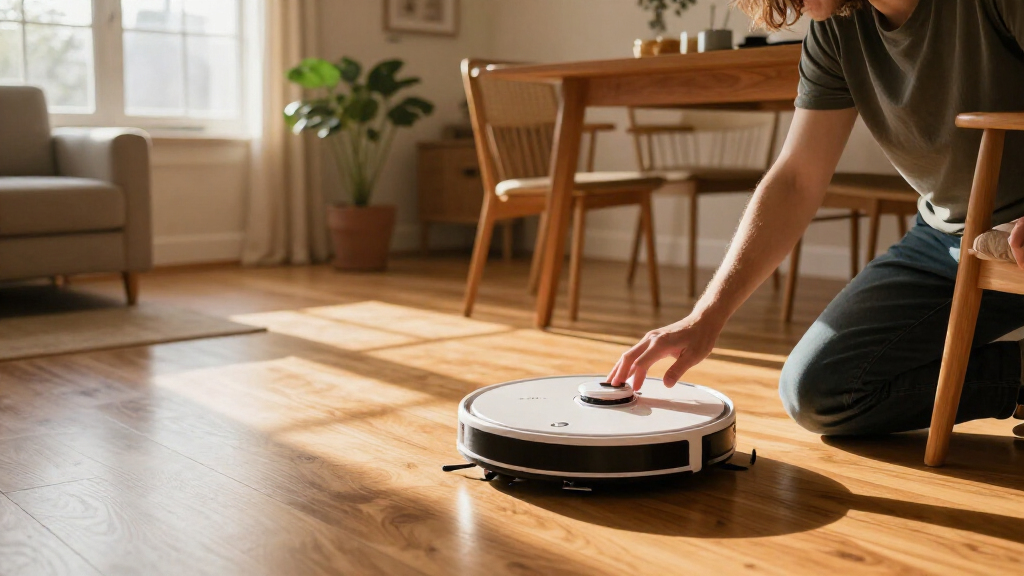
I ranked these robot vacuum cleaners for hardwood floors by how well their stated features address everyday hard-floor needs: collecting dust, crumbs, and hair; managing mop use; and reducing the work of emptying and cleaning the machine. I also weighed usability, dock design, product role, and the practical difference between a vacuum-only model and a vacuum-and-mop combo. Suction figures helped distinguish models with published ratings, but I did not treat a larger number as proof of better real-world cleaning.
The ordering favors models that bring a useful balance of cleaning capability and hands-off care, followed by options with more specialized strengths or simpler setups. A self-emptying or multifunction dock can earn a higher place when its convenience fits the added parts and maintenance, while a basic model can still be a better choice for a buyer who wants fewer features. Since suitability depends on floor finish, rugs, household debris, and tolerance for upkeep, the roundup makes those tradeoffs part of each recommendation rather than treating every feature as a benefit for every reader.
Factors to Consider When Choosing Robot Vacuum Cleaners For Hardwood Floors
Hardwood-friendly robot vacuum shopping is less about chasing the longest feature list and more about matching the machine’s routine to your floors and home. I’d weigh the following factors before deciding between a simple vacuum and a more automated mop combo.
Match Mop Features to Your Floor Finish
A mop attachment can help with fine dust and light marks, but it does not replace careful floor-specific cleaning. Check your flooring manufacturer’s care instructions before using water or a cleaning solution, especially on unfinished, waxed, or damage-prone surfaces. Look for clear controls over water delivery and mop operation rather than assuming every combo treats floors gently. A robot that vacuums well without mopping may be a better fit if you do not want to manage moisture. Also account for the work after a run: reusable pads need attention, and a dock does not necessarily eliminate that task. Avoid buying a combo solely because mopping sounds like a free extra.
Choose Suction With the Whole Cleaning System in Mind
Published suction figures can help compare models, but they do not tell the full story of how a robot handles dust, hair, or crumbs on your particular floor. Brush design, airflow, navigation, and how well the robot reaches edges all affect the result. Hard floors generally do not call for the same carpet-focused priorities as a home with thick rugs, so extra suction may matter less than reliable coverage and pickup. If your home has a mix of hardwood and rugs, check how the robot handles transitions and whether you can set room or zone rules. Treat a high suction number as one data point, not a guarantee of superior cleaning.
Decide How Much Dock Automation You Will Use
Self-emptying docks can reduce how often you handle the robot’s dust bin, which is useful for frequent cleaning or a home with shedding pets. More elaborate stations may also support mop-related care, but each added function brings components that need cleaning, refilling, or occasional attention. A basic charging base is less hands-off, yet it may suit a smaller home where emptying the bin is a minor chore. Before choosing, ask which tasks you genuinely want the dock to take over rather than paying attention only to the word “automatic.” Leave room for the station itself, too, since a larger dock needs a suitable location and access for maintenance.
Check Navigation Against Your Floor Plan
Navigation quality affects whether a robot cleans rooms methodically or spends too much time revisiting open areas. A clear map and useful room controls matter more in homes with several rooms, narrow passages, or furniture that changes position. For a small, open floor plan, a simpler setup may be enough and easier to manage. Think about cables, pet bowls, thresholds, and other objects that can interrupt a run; even a capable robot benefits from a prepared route. If you need to keep the mop out of certain areas, check whether the app or controls can create practical no-go zones. Do not assume that every model with an app offers the same level of mapping control.
Plan for Hair, Filters, Pads, and Replacement Parts
Routine upkeep shapes how convenient a robot feels after the novelty wears off. Hair can collect around brushes, dust can clog filters, and mop pads need regular washing or replacement, so check what the manufacturer asks owners to maintain. A self-emptying dock reduces bin handling but does not make brushes or filters maintenance-free. Homes with pets or long hair may benefit from a design that is easy to inspect and clear. Consider whether replacement bags, filters, and pads are readily available for the exact model. A simpler robot can be the better long-term fit if you prefer fewer consumables and less dock upkeep.
Prioritize Features That Solve a Real Household Problem
It is easy to overvalue a long feature list when a smaller number of useful functions would handle your daily mess. Pet hair, frequent crumbs, a large floor area, or a desire to mop regularly may justify more automation than occasional dust on a compact floor. If you mainly want scheduled pickup, a vacuum-first model with a basic base can keep the routine straightforward. For mixed flooring, prioritize room controls and practical rug handling over a mop function you may rarely use. Think through who will empty, clean, and troubleshoot the robot, not just who will choose it. The right model is the one whose routine you will keep using.
Frequently Asked Questions
Is a robot vacuum with a mop safe for every hardwood floor?
No. Suitability depends on the floor’s finish and the care guidance from its manufacturer, so check that before using a robot mop. Be especially cautious with unfinished, waxed, or water-sensitive flooring. A combo’s mop function can help with light surface dirt, but it is not a reason to leave moisture on the floor or skip routine inspection. If you are unsure, use a vacuum-only model or keep the mop function disabled until you confirm the floor can tolerate it. Also check whether the robot lets you control water use and keep it away from areas that should stay dry.
Should I choose a self-emptying dock if I have mostly hardwood floors?
Floor type alone does not decide whether a self-emptying dock is worthwhile; cleaning frequency and household debris matter more. If you run the robot often, have pets, or want less direct contact with dust, an auto-empty base can reduce a recurring chore. It will not remove the need to clean brushes, filters, or sensors, and mop-equipped stations can add more care tasks. In a small home with light debris, a basic charging base may be easier to live with. Choose the dock for the work it actually removes from your routine.
Does a higher published suction rating mean better cleaning on hardwood?
Not by itself. A high rating can signal strong stated suction, but cleaning also depends on brush design, airflow, navigation, and how the robot approaches edges and obstacles. The Qrevo 2 Pro and Qrevo S Pro stand out in this list for their published suction figures, yet buyers should still compare their dock and mop needs rather than choosing on that number alone. On hardwood, dependable coverage and effective pickup of fine debris may matter more than maximum suction. Treat the rating as a comparison point, not a promise of a particular result in your home.
Is a vacuum-only robot a better choice than a vacuum-and-mop combo for hardwood?
It can be, especially if your floor finish is sensitive to moisture or you already prefer to mop by hand. A vacuum-only model avoids managing water and mop pads, which can make the weekly routine simpler. A combo is more appealing if you want light mopping as part of scheduled floor care and are comfortable maintaining the pad and water system. The Roomba 105 is the clearest vacuum-first option in this roundup, while most other listed models combine vacuuming and mopping. Choose based on the cleaning tasks you will actually use, not the number of functions on the box.
What should I prioritize if my home has hardwood, rugs, and pets?
Start with dependable pickup of hair and debris, then check how the robot handles rugs and whether its controls let you set room-specific routines. A self-emptying dock may be useful if pet hair fills the bin quickly, but it does not eliminate brush cleaning. For a combo, verify that mop operation can be managed around rugs and any areas where moisture is unwelcome. Navigation matters when bowls, toys, or furniture interrupt the route, since a robot that gets stuck can miss floors altogether. A well-managed vacuum routine may suit this mix better than prioritizing the most elaborate mopping station.
Conclusion
For most shoppers, I’d make the Roborock Qrevo 2 Pro my best overall pick because its published 20,000Pa suction and vacuum-and-mop format offer a strong feature set for regular hard-floor care. The best premium choice is the Roborock Qrevo S Pro for buyers drawn to high suction and a more involved dock setup. For best value, I’d shortlist the Tikom G8000 Max or ROPVACNIC 5200Pa based on which listed functions fit your routine; both provide a combo approach without the emphasis on a flagship-class station. The Roomba 105 is my pick for beginners who want a simpler vacuum-first robot, while the Shark AV2501AE makes sense for buyers who specifically want a vacuum with an XL HEPA self-empty base. If your hardwood finish is sensitive to moisture, favor a vacuum-only routine; if you want recurring light mop care, choose a combo whose upkeep you are willing to manage.