
Smart obstacle avoidance matters because it helps your cleaning device navigate efficiently around furniture, walls, pets, and people, reducing collisions and wear. It guarantees thorough cleaning by adapting to changing environments and avoiding getting stuck. With advanced sensors and real-time mapping, your device can protect your belongings and operate safely without supervision. This leads to less effort on your part and a more reliable, effective cleaning. Keep exploring to discover how this technology makes your home smarter and cleaner.

Get cleaning gear delivered free with Prime
- Fast, free delivery on millions of items
- Prime Video, Amazon Music and more included
- Member-only deals all year
Key Takeaways
- Prevents collisions, reducing device damage and extending lifespan.
- Ensures thorough cleaning by navigating around furniture and obstacles efficiently.
- Protects furniture, pets, and people from accidental bumps or injuries.
- Allows autonomous operation without user supervision or debris clearing.
- Enhances cleaning performance by adapting to changing environments in real time.

Smart obstacle avoidance has transformed the way cleaning devices operate, making them more efficient and user-friendly. When you rely on a robotic cleaner, you want it to work seamlessly around your home or office, without constant supervision. That’s where advanced robot navigation and sensor technology come into play. These innovations enable your device to detect, interpret, and respond to obstacles in real time, guaranteeing thorough cleaning without collisions or missed spots. This means less frustration for you and a more effective clean for your space.
With smart obstacle avoidance, your cleaning device actively maps out its environment using a combination of sensors—such as infrared, ultrasonic, or LIDAR. These sensors gather detailed information about furniture, walls, and even moving objects like pets or people. The robot continuously analyzes this data to create a dynamic map, allowing it to plan the most efficient route. This advanced robot navigation minimizes redundant passes and helps prevent your device from getting stuck or causing damage. It’s like giving your cleaner a sense of sight and awareness, making it smarter and more adaptable. Incorporating sensor fusion techniques can further enhance obstacle detection accuracy and environmental understanding.
Smart sensors like infrared, ultrasonic, and LIDAR help cleaning robots map environments and plan efficient, obstacle-free routes.
Sensor technology is the backbone of this intelligence. It enables your device to distinguish between different types of obstacles and respond appropriately. For example, it can detect a chair leg and navigate around it smoothly, or recognize a human walking nearby and adjust its path to avoid interference. Some systems even use depth sensors to gauge the size and shape of obstacles, providing a more precise understanding of the environment. This level of sophistication not only improves cleaning performance but also prolongs the lifespan of your device by reducing collisions and mechanical wear. Additionally, understanding the importance of color accuracy and contrast ratio can further enhance the visual quality of your home cinema setup for more enjoyable viewing experiences. Moreover, advancements in sensor technology continue to make these devices more intelligent and capable of handling complex environments. Recognizing the significance of real-time data processing allows these robots to react instantly to unexpected obstacles, further improving their efficiency.
You’ll appreciate how smart obstacle avoidance makes your life easier. Instead of babysitting your robotic cleaner or constantly clearing debris, you can set it to work and trust that it will handle obstacles intelligently. It adapts to changing environments, learning from its encounters and refining its navigation over time. This means fewer missed spots and a cleaner home, with less effort on your part. The combination of robot navigation and sensor technology creates a seamless, autonomous cleaning experience that’s more reliable and effective than ever before.
Ultimately, smart obstacle avoidance isn’t just a fancy feature—it’s a critical component that guarantees your cleaning device performs at its best in real-world settings. It’s what allows your robot to move confidently, clean efficiently, and give you peace of mind knowing that your space is well-maintained without constant oversight.
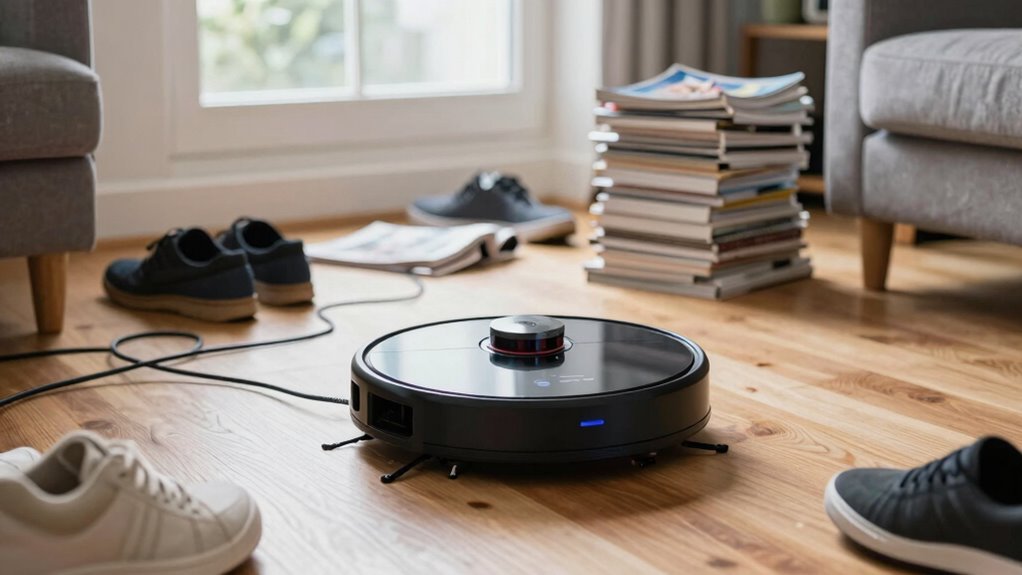
robot vacuum with obstacle avoidance
As an affiliate, we earn on qualifying purchases.
As an affiliate, we earn on qualifying purchases.
Frequently Asked Questions
How Does Obstacle Avoidance Technology Impact Cleaning Efficiency?
Obstacle avoidance technology boosts your cleaning efficiency by enhancing navigation accuracy and sensor integration. It helps your device swiftly detect and navigate around obstacles, reducing missed spots and cleaning time. With precise sensors working together, your cleaner adapts seamlessly to changing environments, avoiding collisions and ensuring thorough coverage. This smart system minimizes interruptions, allowing you to enjoy a faster, more effective cleaning process without constant supervision.
Can Smart Obstacle Avoidance Adapt to Changing Environments?
Yes, smart obstacle avoidance can adapt to changing environments through dynamic adaptation and environmental sensitivity. You’ll find that these systems continuously monitor surroundings, adjusting their paths in real-time as conditions evolve. This means your cleaning device can navigate around unexpected obstacles or layout changes effortlessly, ensuring thorough coverage and efficient operation. By responding promptly to environmental variations, the system maintains peak performance and minimizes disruptions during your cleaning tasks.
What Are Common Challenges Faced by Obstacle Avoidance Systems?
You might face challenges like sensor limitations, which can cause blind spots or false readings, making obstacle detection unreliable. Additionally, algorithm accuracy plays a vital role; if the software misinterprets sensor data, it could lead to collisions or missed obstacles. Environmental factors like lighting, clutter, or moving objects also complicate obstacle avoidance, requiring robust systems that can adapt quickly and reliably.
How Does Obstacle Detection Differ Between Robot Models?
Imagine a robot so smart it’s like a hawk hunting for obstacles. You’ll notice how different models excel in sensor accuracy and obstacle recognition. Some use advanced lidar or infrared sensors for precise detection, while others rely on basic bump sensors. This variation impacts how well they navigate around furniture, toys, or cords, making some models better suited for complex spaces. Your choice depends on how detailed and reliable you need obstacle detection to be.
Is Obstacle Avoidance Technology Cost-Effective for Home Cleaning?
Yes, obstacle avoidance technology is cost-effective for home cleaning. It helps you save time and reduces the need for manual intervention, leading to significant cost savings over time. With advanced technology integration, your robot can efficiently navigate around furniture and obstacles, preventing damage and avoiding costly repairs. Investing in these smart features guarantees thorough cleaning, minimizes missed spots, and prolongs your device’s lifespan, making it a smart financial choice.
Conclusion
Imagine a robot maneuvering a cluttered room like a cautious explorer, gracefully sidestepping furniture and toys without a stumble. That’s what smart obstacle avoidance offers—seamless, efficient cleaning without interruptions. Studies show that these intelligent systems can reduce cleaning time by up to 30%. When your device “thinks ahead,” it’s like having a vigilant assistant who never misses a spot or bumps into surprises. That’s the power of smart obstacle avoidance in real-world cleaning.
Halloween Picks
halloween
As an affiliate, we earn on qualifying purchases.