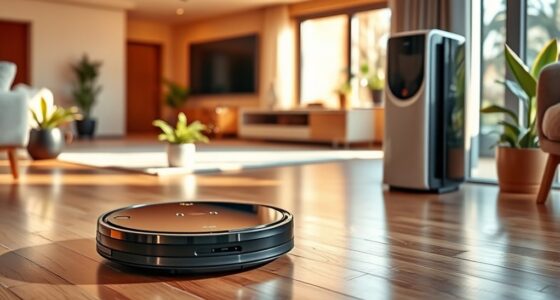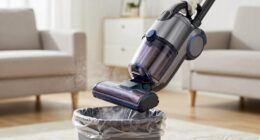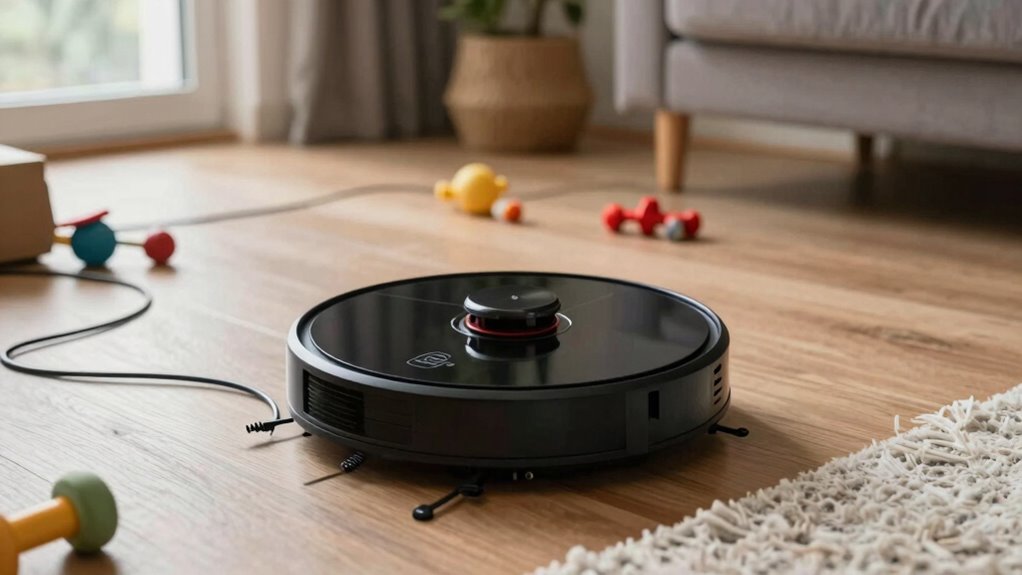
Obstacle avoidance greatly enhances your robot vacuum’s performance by helping it detect and navigate around furniture, objects, and sudden changes in the environment. It uses advanced sensors and algorithms to create a dynamic map, avoiding obstacles efficiently and preventing it from getting stuck or missing spots. This technology guarantees a more thorough clean, reduces manual intervention, and allows for smoother navigation around complex spaces. Keep exploring how these features can transform your cleaning experience.
Key Takeaways
- Enhances navigation accuracy, reducing collisions and preventing damage to furniture and the vacuum itself.
- Increases cleaning efficiency by allowing the robot to cover more area without unnecessary stops.
- Minimizes manual intervention through adaptive route adjustments in dynamic or cluttered environments.
- Improves obstacle detection with advanced sensors, leading to fewer missed spots and thorough cleaning.
- Enables smoother movement around room contours, reducing getting stuck and ensuring consistent performance.
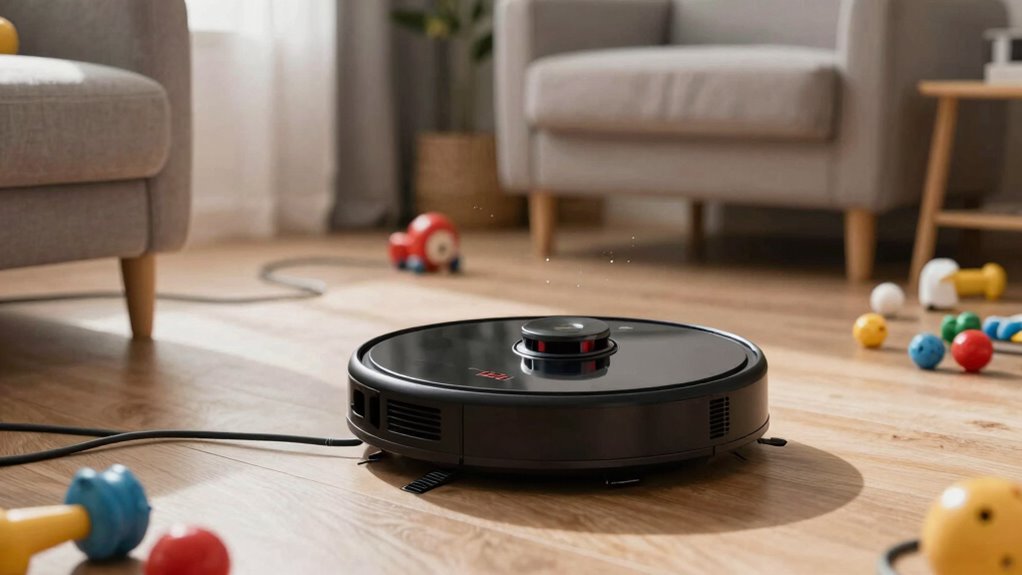
Robot vacuums have revolutionized household cleaning by autonomously steering your space, but their ability to avoid obstacles is vital to effective performance. At the heart of this capability are navigation algorithms that process data and plan paths, enabling the vacuum to move efficiently while avoiding furniture, cords, and other objects. These algorithms analyze the environment in real-time, adjusting the vacuum’s route to guarantee thorough cleaning without getting stuck or missing spots. Sensor integration plays an essential role in obstacle avoidance. Most modern robot vacuums are equipped with a combination of sensors—like infrared, ultrasonic, and bump sensors—that detect nearby objects. Infrared sensors emit signals that bounce back from obstacles, helping the vacuum gauge distance and shape its path accordingly. Ultrasonic sensors measure the time it takes for sound waves to reflect back, providing additional spatial awareness. Bump sensors detect physical contact, prompting immediate changes in direction when the device encounters an obstacle unexpectedly. Together, these sensors create an all-encompassing picture of your environment, allowing the vacuum to respond swiftly and accurately. The effectiveness of obstacle avoidance depends heavily on the quality of sensor data and how well the algorithms interpret this information. Effective navigation algorithms make sense of data from all these sensors, creating a dynamic map of the space. This map isn’t static; it updates constantly as the robot moves around, helping it avoid obstacles and adapt to changes. For example, if a chair leg suddenly becomes visible or a new object is placed in its path, the vacuum’s sensors pick up the change, and the algorithms recalibrate the route, preventing collisions or entrapment. This seamless integration of sensor data with smart algorithms ensures the vacuum cleans thoroughly, even in cluttered or complex spaces. Additionally, accurate environment mapping enhances the robot’s ability to navigate efficiently by building detailed layouts of your home. These detailed maps are often improved over time through machine learning, allowing the vacuum to adapt and optimize its cleaning patterns based on past experiences. Advances in sensor technology continue to improve obstacle detection accuracy, making these devices even more reliable. The difference obstacle avoidance makes in real-world performance is notable. Without advanced navigation algorithms and sensor integration, the vacuum might bump into furniture repeatedly or miss entire areas. It could get stuck under tables or behind appliances, reducing cleaning efficiency. But with sophisticated obstacle avoidance, the vacuum navigates smoothly around obstacles, contours to the room’s layout, and covers more ground in less time. This results in a more thorough clean, fewer interruptions, and less need for manual intervention.

ROPVACNIC Robot Vacuum Cleaner Robot Vacuum and Mop Combo with 5200Pa Suction, Personalized Cleaning Adjustments, Self-Charging Robotic Vacuum Cleaner, Advanced Obstacle Avoidance
【2-in-1 Mopping and Vacuuming】 The ROPVACNIC Robot S1 integrates advanced electronically controlled mopping technology, significantly enhancing both cleaning…
As an affiliate, we earn on qualifying purchases.
As an affiliate, we earn on qualifying purchases.
Frequently Asked Questions
How Does Obstacle Avoidance Affect Battery Life?
Obstacle avoidance can decrease your robot vacuum’s battery life because it increases power consumption. When the robot navigates around obstacles, it uses extra energy for sensors and processing, which reduces overall battery efficiency. However, this feature helps it clean more thoroughly and avoid damage. So, while it might drain the battery a bit faster, it ultimately guarantees better cleaning performance and reduces the need for frequent recharging or repairs.
Can Obstacle Avoidance Cause Missed Spots or Incomplete Cleaning?
Yes, obstacle avoidance can cause missed spots or incomplete cleaning. When your vacuum relies on navigation efficiency and sensor accuracy, it might detect obstacles and avoid certain areas, leading to gaps. Sometimes, sensors misjudge a surface or obstacle, causing the robot to skip sections or change its path unexpectedly. To minimize this, make sure your sensors are clean and calibrated, helping the vacuum navigate more precisely and clean more thoroughly.
What Sensors Are Used for Obstacle Detection?
You’ll find that most robot vacuums use a combination of sensors like infrared, ultrasonic, and optical ones for obstacle detection. These sensors offer impressive accuracy, helping your device navigate smoothly without bumping into things. As a result, your vacuum can clean more efficiently, avoiding obstacles while covering every inch. The key is the sensor accuracy, which *guarantees* reliable obstacle detection, making your cleaning experience hassle-free and thorough.
Does Obstacle Avoidance Increase Cleaning Noise Levels?
Obstacle avoidance can increase cleaning noise levels because it often requires the vacuum to make more frequent turns and adjustments, leading to noise disruption. These maneuvers can create acoustic interference, making the vacuum noisier during operation. You might notice additional sounds as the robot detects and navigates around obstacles, especially in tight or cluttered spaces. However, the overall noise increase is usually minimal and balanced by more efficient cleaning paths.
How Do Different Floor Types Impact Obstacle Avoidance?
Different floor types impact obstacle avoidance because textured floors like carpets increase obstacle complexity, making navigation harder. Smooth surfaces, such as hardwood or tile, allow the robot to detect obstacles more easily, improving navigation accuracy. You’ll notice that on carpets, the vacuum might slow down or struggle with small objects, while on hard floors, it navigates more smoothly. Adjusting settings or upgrading sensors can help your robot handle various floor textures better.

Redroad Robot Vacuum 20,000 Pa Robot Vacuum and Mop,90 Day Self Emptying Vacuum Robot,Lidar Navigation,5G/2.4GWiFi APP Aspirateur Robot,Self-Charging Robot Vacuums for Pet,Floor,Carpet Gray R11
【𝟮𝟬,𝟬𝟬𝟬 𝗣𝗮 𝗦𝘂𝗽𝗲𝗿 𝗦𝘂𝗰𝘁𝗶𝗼𝗻 & 𝟯𝟮𝟬𝟬 𝗺𝗔𝗵 𝗛𝗶𝗴𝗵-𝗖𝗮𝗽𝗮𝗰𝗶𝘁𝘆 𝗕𝗮𝘁𝘁𝗲𝗿𝘆】- The R11 robot vacuums boasts a powerful suction of…
As an affiliate, we earn on qualifying purchases.
As an affiliate, we earn on qualifying purchases.
Conclusion
Obstacle avoidance in robot vacuums is like a skilled dancer, gracefully weaving through furniture and clutter, ensuring every inch is covered without a misstep. By enhancing navigation, your robot becomes a reliable partner in maintaining a spotless home, turning chaos into harmony. With smarter obstacle detection, you’ll notice fewer missed spots and fewer bumps, making cleaning feel effortless. Embrace these improvements, and watch your robot’s performance glide smoothly, transforming your cleaning routine into a seamless, choreographed routine.

Goodsby Replacement Cliff Drop Infrared Side Sensors for Shark IQ Robot Vacuums RV1001AE RV912S RV913S RV1000S QR1000SG AV1002AE AV1010AE AV911S QR1000SB UR1000SR UR1005AE RV1101ARUS UR1105ARUS
✅ !!! CHECK YOUR VACUUM MODEL BEFORE ORDERING !!! ✅
As an affiliate, we earn on qualifying purchases.
As an affiliate, we earn on qualifying purchases.

Tapo Ultra-Slim LiDAR Smart Navigation Robot Vacuum and Mop with Self-Emptying Dock, 5300Pa Max, 97%+ Dust Pickup Rate, Self-Charging, Compatible with Alexa & Google Home, RV20 Max Plus
𝗘𝗳𝗳𝗶𝗰𝗶𝗲𝗻𝘁𝗹𝘆 𝗖𝗹𝗲𝗮𝗻𝘀 𝗬𝗼𝘂𝗿 𝗛𝗼𝗺𝗲: Effectively removes dust, pet hair, crumbs, and debris from all hardwood flooring surfaces and…
As an affiliate, we earn on qualifying purchases.
As an affiliate, we earn on qualifying purchases.