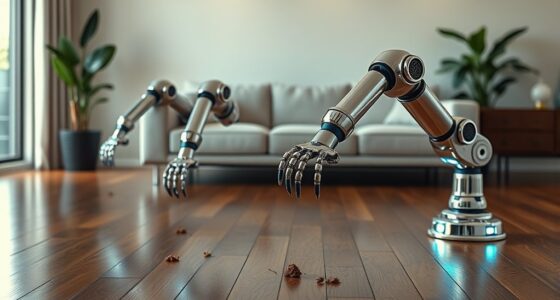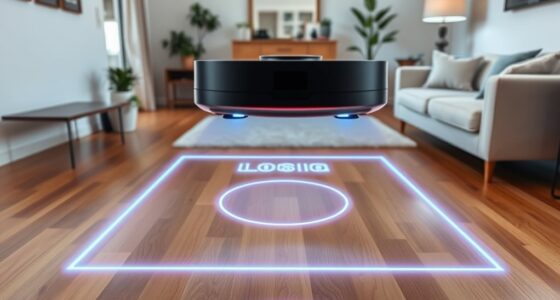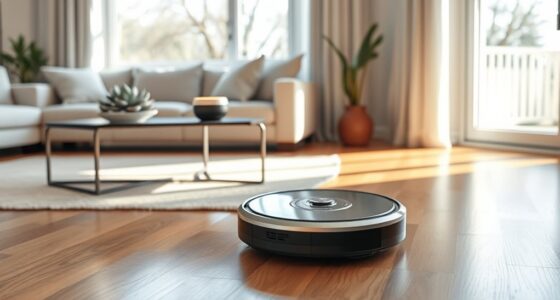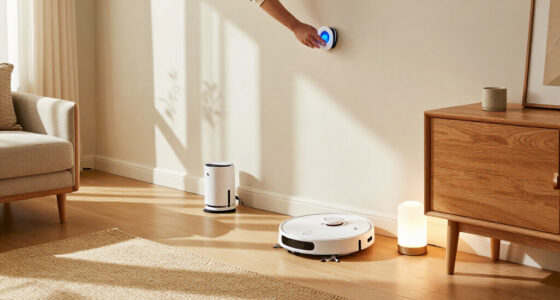
To make your robot vacuum work effectively on mixed flooring, regularly maintain its brushes, sensors, and dustbins for smooth operation. Adjust cleaning modes and set specific zones for thorough coverage, especially on different surfaces. Remove obstacles, reposition furniture, and clear loose rugs to prevent getting stuck. Use boundary markers to restrict access to certain areas. Keeping your vacuum well-maintained and utilizing advanced features allows seamless shifts across floors—learn more to maximize its performance on every surface.

Get cleaning gear delivered free with Prime
- Fast, free delivery on millions of items
- Prime Video, Amazon Music and more included
- Member-only deals all year
Key Takeaways
- Enable surface recognition features to automatically adjust cleaning modes for different flooring types.
- Manually set specific zones or boundaries to focus cleaning on mixed surfaces.
- Regularly maintain sensors, brushes, and dustbins to ensure effective transition across floors.
- Reposition furniture and remove obstacles to facilitate smoother navigation on varied surfaces.
- Use firmware updates and advanced features for adaptive cleaning tailored to mixed flooring environments.

If your home has a mix of carpets, hardwood, and tile, ensuring your robot vacuum cleans effectively can be challenging. Different surfaces require different cleaning strategies, and your robot vacuum needs to adapt to each one for optimal performance. To do this, you should start with regular robot vacuum maintenance. Clearing out dustbins, checking brushes, and ensuring sensors are clean will help your device operate smoothly across all flooring types. A well-maintained vacuum is less likely to get stuck or miss spots, especially when transitioning between surfaces.
Regular maintenance ensures your robot vacuum adapts smoothly to all flooring types for optimal cleaning.
Battery life optimization is equally important for effective cleaning sessions. When your robot vacuum is in good shape, it uses power more efficiently, helping it cover larger areas without needing frequent recharging. Adjusting cleaning schedules to avoid running the vacuum when the battery is low prevents incomplete cleanings. Some models allow you to set specific cleaning zones or customize cleaning modes based on the surface type, which can conserve battery life. For instance, you might set a higher suction power for carpets and a lower setting for hardwood or tile, extending the runtime and ensuring thorough cleaning without draining the battery too quickly.
To make your robot vacuum work seamlessly on mixed flooring, consider programming it to recognize different surfaces. Many modern models come with sensors or mapping technology that adjusts cleaning intensity automatically. If your vacuum lacks this feature, you can manually guide it to focus on problematic areas or use boundary markers to restrict it from certain surfaces. Regularly updating your vacuum’s firmware can also improve its surface recognition capabilities and overall efficiency. Additionally, surface detection technology can significantly enhance your vacuum’s adaptability across various flooring types. Incorporating adaptive cleaning features can further improve its performance in diverse environments. Being aware of your vacuum’s sensor accuracy can help you troubleshoot issues related to surface recognition and ensure better cleaning results.
Another tip is to prepare your floors before cleaning. Remove loose rugs that could cause the vacuum to get stuck and reposition furniture or objects obstructing pathways. This reduces the chances of the vacuum struggling or wasting energy navigating around obstacles, which in turn conserves battery power and improves cleaning effectiveness.
Lastly, consider investing in a robot vacuum with adjustable cleaning modes and good surface detection. When combined with routine maintenance and thoughtful scheduling, these features help your vacuum adapt to your home’s diverse flooring. Maintaining your device and optimizing its battery life aren’t just about keeping it in working order—they’re about making sure it cleans thoroughly, efficiently, and consistently across every surface in your home.
robot vacuum surface recognition sensors
As an affiliate, we earn on qualifying purchases.
As an affiliate, we earn on qualifying purchases.
Frequently Asked Questions
Can Robot Vacuums Identify Different Floor Types Automatically?
Yes, many robot vacuums can identify different floor types automatically thanks to floor detection technology. They use sensors to analyze surface textures and adjust cleaning settings accordingly. To keep this feature working properly, you should regularly perform sensor maintenance, like cleaning dust and debris, which guarantees accurate detection. This way, your robot vacuum can efficiently switch between carpets and hard floors, providing ideal cleaning performance.
How Often Should I Clean the Robot Vacuum’s Sensors?
You should clean your robot vacuum’s sensors every two to four weeks. Imagine a homeowner noticing their vacuum struggles with dirt detection on thick carpets; regular sensor maintenance could resolve this. Dirt buildup on sensors hampers their ability to detect obstacles and dirt effectively. Keep sensors clear of dust and debris to guarantee peak performance, especially on mixed flooring, where precise dirt detection is essential for thorough cleaning.
Do Robot Vacuums Work Better With Specific Flooring Materials?
Robot vacuums tend to work better on certain flooring materials, especially those with higher flooring durability like hardwood or tile. They handle these surfaces more efficiently, while carpet sensitivity varies—lower-pile carpets usually work well, but thick, plush carpets can challenge their suction and navigation. To optimize performance, adjust the vacuum’s settings based on your flooring type, ensuring it navigates smoothly without getting stuck or missing spots.
Can Robot Vacuums Handle Area Rugs With High Pile?
Did you know that 75% of robot vacuum owners struggle with high pile challenges? Yes, robot vacuums can handle area rugs with high pile, but their effectiveness depends on the model. For best area rug maintenance, choose a robot with strong suction and adjustable height settings. Be aware that some models may get stuck or miss spots, so regular manual checks help maintain your high pile rugs’ cleanliness and longevity.
What Is the Maximum Transition Height the Robot Vacuum Can Manage?
Your robot vacuum can typically handle changeover thresholds up to 0.5 inches high, but it varies by model. To improve performance, guarantee proper sensor calibration so the vacuum detects changes in floor height accurately. Large or uneven changeover thresholds may cause it to get stuck or miss spots. Regularly check and adjust the sensors, and consider using a ramp or low-profile accessory for higher thresholds to enhance navigation.
Conclusion
By adjusting your robot vacuum’s settings and choosing the right model, you make cleaning mixed flooring feel like a breeze—like a skilled dancer seamlessly moving across different surfaces. With a little patience and the right approach, your robot can effortlessly handle everything from carpets to hardwoods. Remember, the key is to stay proactive and fine-tune your device as needed. Soon, you’ll enjoy a spotless home, and your vacuum will work like a well-trained performer on stage.
Halloween Picks
halloween
As an affiliate, we earn on qualifying purchases.