Editorial update log
November 13, 2026:
Deal update: RoundupForge price history now flags ASIN B0BN2MGV5H on amazon.com as below its typical tracked range. RF labels the deal as near_low.
Exact pricing remains intentionally gated through the live Grimfaste price module in the article.
For most buyers seeking the best air purifier for PM2.5, I’d start with the Blueair Blue Pure 211i Max for large-room performance, then compare the Levoit Vital 200S-P for smart controls and the DREO Air Purifier for its built-in PM2.5 monitor. The right choice depends on more than a headline room-size figure: filtration details, clean-air delivery, fan noise, and replacement-filter access all affect everyday use. A larger unit may clear a room faster but take up more space, while a compact or quieter model may suit a bedroom better. Sensor readouts can help track changes, but they do not replace strong particle filtration or good placement. Read on for my full comparison and the tradeoffs behind each pick.

Get cleaning gear delivered free with Prime
- Fast, free delivery on millions of items
- Prime Video, Amazon Music and more included
- Member-only deals all year
Complete the kit



Key Takeaways
- Room coverage and practical cleaning performance are not interchangeable: I give more weight to a purifier’s stated performance and usable fan settings than to the largest square-foot figure on its box.
- The Blueair Blue Pure 211i Max and Levoit Vital 200S-P serve different large-room priorities: Blueair leads this lineup for broad-room use, while Levoit adds smart controls for buyers who want remote operation.
- PM2.5 monitoring is most useful when it changes how you run the unit: The DREO and several sensor-equipped models can show particle readings, but a display alone does not make a purifier clean faster.
- Washable pre-filters address upkeep, not the full filter job: They can catch larger debris and reduce cleaning on the main filter, but buyers still need to account for the primary filter’s replacement schedule.
- Several ECOSELF models and other large-room units overlap: Their room-size claims make filter details, controls, dimensions, and maintenance especially important when choosing between similar-looking options.
| FreAire HAP605 Air Purifier for Large Rooms, White |  | Best Overall for Large-Space PM2.5 Monitoring | Model: HAP605 | Coverage area: Up to 2,600 sq. ft. | Air intake: Front and two side inlets | VIEW LATEST PRICE | See Our Full Breakdown |
| Air Purifier for Pets with Washable Pre-Filter, H13 HEPA Filtration, and Auto Mode |  | Best for Pet Homes | Coverage area: Up to 2,500 ft² | Filtration: Three-stage: washable pre-filter, H13 HEPA, activated carbon | Air quality monitoring: PM2.5 sensor with AQI light ring | VIEW LATEST PRICE | See Our Full Breakdown |
| ECOSELF Air Purifier for Large Rooms up to 2,400 sq ft |  | Best for Large Rooms with a Stated Air-Change Rate | Coverage area: Up to 2,400 sq. ft. | Air changes: Twice per hour | Filtration efficiency: Captures 99.97% of airborne particles | VIEW LATEST PRICE | See Our Full Breakdown |
| ECOSELF Air Purifier for Large Rooms up to 2,400 sq ft with True HEPA Filter |  | Best True HEPA Pick for Large Rooms | Coverage area: Up to 2,400 sq. ft. | Filtration: True HEPA; captures 99.97% of airborne particles | Air changes: Twice per hour | VIEW LATEST PRICE | See Our Full Breakdown |
| DREO Air Purifier with HEPA Filter, PM2.5 Monitor, Auto and Sleep Modes |  | Best for Smaller Rooms with Fast Air Turnover | Model: DR-HAP008 (Dreo 338) | CADR: 115 CFM | Coverage at 4.8 ACH: Up to 178 sq. ft. | VIEW LATEST PRICE | See Our Full Breakdown |
| ECOSELF Air Purifier for Large Rooms up to 1,800 sq. ft. |  | Best for Quiet Bedroom Use | Coverage area: Up to 1,800 sq. ft. | Air intake: 360° | Filtration: Pre-filter, HEPA filter, and activated carbon layer | VIEW LATEST PRICE | See Our Full Breakdown |
| Afloia Europa Air Purifier for Large Rooms, with PM2.5 Display |  | Best for Visible PM2.5 Readings | CADR: 280 m³/h | Room coverage: Up to 2,000 sq. ft. | Air changes: 5 per hour in 320 sq. ft. | VIEW LATEST PRICE | See Our Full Breakdown |
| MOOKA Air Purifier for Large Rooms, White |  | Best for Washable Pre-Filter Maintenance | Coverage: Up to 2,200 ft² | Filtration: Three-stage system with HEPA filter, washable pre-filter, and activated carbon pellets | Air quality sensor: PM2.5 sensor with digital display | VIEW LATEST PRICE | See Our Full Breakdown |
| Hopmirth Air Purifier for Home & Bedroom with H14 True Filter |  | Best for H14 Filtration and Simple PM2.5 Feedback | Filter type: H14 True Filter | Coverage area: Up to 2,000 sq. ft. | Sleep Mode noise: 24 dB | VIEW LATEST PRICE | See Our Full Breakdown |
| Blueair Blue Pure 211i Max Air Purifier for Large Rooms |  | Best for Fast, App-Connected Room Cleaning | Model: Blue Pure 211i Max | Room coverage: Up to 674 sq. ft. in 12.5 minutes; up to 3,235 sq. ft. in one hour | Filtration technology: HEPASilent dual filtration | VIEW LATEST PRICE | See Our Full Breakdown |
| Akeelia HEPA Air Purifier for Large Rooms, Up to 3,000 sq ft, with Washable Pre-Filter and PM2.5 Sensor | 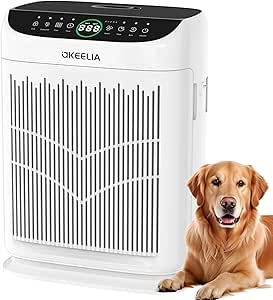 | Best for Very Large Spaces | Coverage: Up to 3,000 sq ft | Filtration: HEPA filter with washable pre-filter | Air intake: Double-sided, 360° | VIEW LATEST PRICE | See Our Full Breakdown |
| KNKA APH4000 Air Purifier for Home, White |  | Best for Pet Homes | Model: APH4000 | Smoke/dust/PM2.5 CADR: 226 CFM (384 m³/h) | Pollen CADR: 244 CFM (415 m³/h) | VIEW LATEST PRICE | See Our Full Breakdown |
| Levoit Eleva 300X Air Purifier with Sealed HEPA Filtration |  | Best for Detailed PM Monitoring | Coverage: Up to 1,200 sq ft | CADR: 161 CFM | Filtration: Sealed, three-stage HEPA | VIEW LATEST PRICE | See Our Full Breakdown |
| AirHub Air Purifier with Dual-Sided Intake for Rooms up to 1,092 sq. ft. |  | Best Quiet Pick with Included Filter Set | Coverage: Up to 1,092 sq ft at 1 ACH | Air changes: 4.8 ACH in a 209 sq ft room | Filtration: Dual three-stage systems with washable pre-filters, True HEPA, and activated carbon | VIEW LATEST PRICE | See Our Full Breakdown |
| LEVOIT Vital 200S-P Smart Air Purifier for Large Rooms, White |  | Best for Large Rooms with CADR Data | Model: Vital 200S-P | Coverage: Up to 1,875 sq ft | Smoke CADR: 250 CFM | VIEW LATEST PRICE | See Our Full Breakdown |
More Details on Our Top Picks
FreAire HAP605 Air Purifier for Large Rooms, White
The FreAire HAP605 is my strongest fit here for buyers who want PM2.5-responsive operation across a large area. Its sensor feeds Auto Mode, which adjusts the fan as readings change, while the three-sided air intake draws from the front and both sides. That layout gives it a different emphasis from the DREO DR-HAP008, whose published coverage is more modest when run at a faster air-change rate. FreAire also keeps nighttime operation simple: Sleep Mode is rated at 20 dB and switches off the display lights. The washable pre-filter helps with routine upkeep, but it does not eliminate the need to replace the main filter every three to six months. Buyers should also account for the manufacturer’s recommendation to use genuine FreAire filters.
Pros:- PM2.5 sensor lets Auto Mode adjust fan speed as air readings change.
- Three-sided intake draws air from the front and both sides.
- Washable pre-filter supports regular maintenance.
- 20 dB Sleep Mode turns off display lights for a darker bedroom.
Cons:- Main filter replacement is recommended every three to six months, depending on use and indoor conditions.
- Manufacturer recommends genuine FreAire replacement filters.
- Coverage is listed as up to 2,600 sq. ft., but an air-change rate for that area is not provided.
Best for: People who want PM2.5-based Auto Mode and broad room coverage, with enough space to place a purifier that draws air from three sides.
Not ideal for: Buyers seeking clearly specified frequent air changes across the entire claimed coverage area, or those who want flexibility to use non-brand replacement filters.
- Model:HAP605
- Coverage area:Up to 2,600 sq. ft.
- Air intake:Front and two side inlets
- Air quality monitoring:PM2.5 sensor with display
- Modes:Auto, Turbo Pet, Sleep
- Sleep Mode noise:20 dB
- Pre-filter:Washable and reusable
- Main-filter replacement:Every 3–6 months
- Warranty:1 year
Our verdict“Choose the FreAire HAP605 for large-room PM2.5 monitoring and quiet sleep operation, provided you accept recurring brand-specific filter replacement.”
Air Purifier for Pets with Washable Pre-Filter, H13 HEPA Filtration, and Auto Mode
This purifier makes the most sense for homes balancing PM2.5 tracking with pet hair and household odors. Its three-stage filtration pairs a washable pre-filter with an H13 HEPA filter and activated carbon, so it addresses more than airborne particles alone. The PM2.5 sensor drives Auto Mode, and an AQI light ring gives a visible status cue. Compared with the FreAire HAP605, it offers more explicitly described filtration layers and a child lock, while its listed coverage is slightly smaller at up to 2,500 ft². Bedroom-friendly extras include a 22 dB Sleep Mode, timer, and aromatherapy pad. The tradeoff is ongoing maintenance: the main filter is due every three to six months, and replacements use the specific MK-AP02 format.
Pros:- Three-stage filtration includes washable pre-filter, H13 HEPA, and activated carbon.
- PM2.5 sensor adjusts fan speed in Auto Mode and pairs with an AQI light ring.
- 22 dB Sleep Mode, timer, and child lock suit bedroom and family use.
- No ozone-generating technology is specified.
Cons:- Main filter replacement is recommended every three to six months.
- Replacement filter is the specific MK-AP02 model.
- Coverage is listed up to 2,500 ft² without a corresponding air-change rate.
Best for: Pet owners who want PM2.5-responsive operation alongside a washable hair-catching pre-filter and an activated-carbon layer for household odors.
Not ideal for: Buyers who want broadly interchangeable replacement filters or need a stated air-change rate to judge performance at the maximum listed room size.
- Coverage area:Up to 2,500 ft²
- Filtration:Three-stage: washable pre-filter, H13 HEPA, activated carbon
- Air quality monitoring:PM2.5 sensor with AQI light ring
- Operating modes:Auto Mode and Sleep Mode
- Sleep Mode noise:22 dB
- Timer:2, 4, or 8 hours
- Main-filter replacement:Every 3–6 months
- Replacement filter:MK-AP02
- Additional features:Filter reminder, child lock, aromatherapy pad
Our verdict“Pick this model for a pet household that wants particle monitoring plus odor and hair management, and is comfortable sourcing MK-AP02 filters.”
ECOSELF Air Purifier for Large Rooms up to 2,400 sq ft
The ECOSELF 2,400 sq. ft. model stands out for stating how often it refreshes air at its advertised coverage: twice per hour. That figure gives buyers more context than the broad coverage claims on the FreAire HAP605 and the pet-focused purifier, neither of which lists an air-change rate in the supplied specifications. Its PM2.5 display and infrared sensor can adjust fan speed automatically, while the HEPA system is specified to capture 99.97% of airborne particles. Sleep Mode is rated at 22 dB, and the unit adds a timer, lock controls, and aromatherapy. The limitation is that twice-per-hour circulation may not suit people who want faster cleaning in a large room. ECOSELF also recommends official replacement filters.
Pros:- Coverage specification includes an air-change rate of twice per hour.
- PM2.5 display and infrared sensor support automatic fan adjustment.
- HEPA system is specified to capture 99.97% of airborne particles.
- 22 dB Sleep Mode, timer, and lock controls offer flexible operation.
Cons:- Twice-per-hour air changes may be too slow for buyers seeking faster turnover.
- Manufacturer recommends official ECOSELF replacement filters.
- A specific main-filter replacement interval is not provided.
Best for: Buyers comparing large-room purifiers who want a stated air-change rate alongside PM2.5 monitoring and automatic fan adjustment.
Not ideal for: People who need rapid, frequent air turnover across a large space or who prefer to choose from a wide range of replacement filters.
- Coverage area:Up to 2,400 sq. ft.
- Air changes:Twice per hour
- Filtration efficiency:Captures 99.97% of airborne particles
- Air quality monitoring:PM2.5 display and infrared sensor
- Automatic operation:Automatic fan adjustment
- Sleep Mode noise:22 dB
- Modes and controls:Auto, Sleep, timer, fan speed, lock controls
- Certifications:ETL, FCC, EPA, CARB, DOE
- Warranty and support:30-day money-back guarantee, 1 year+ warranty, lifetime technical support
Our verdict“Choose this ECOSELF if a stated two air changes per hour matters more than faster circulation or flexible filter sourcing.”
ECOSELF Air Purifier for Large Rooms up to 2,400 sq ft with True HEPA Filter
This ECOSELF version is the clearest choice for buyers who want the filtration type named directly: it specifies a True HEPA filter and a 99.97% particle-capture claim. Like the other ECOSELF 2,400 sq. ft. model in this lineup, it lists two air changes per hour and uses a PM2.5 display with an infrared sensor to adjust fan speed. That makes the pair look closely matched on the core PM2.5 details; this listing is more explicit about True HEPA, while the other supplies warranty and support information. The 22 dB Sleep Mode, timer, and lock controls add day-to-day flexibility. Its main tradeoffs are the modest stated air-change rate and the recommendation to use ECOSELF replacement filters. Aromatherapy is listed, but its operating details are not.
Pros:- True HEPA filtration is specified to capture 99.97% of airborne particles.
- PM2.5 display and infrared sensor adjust fan speed automatically.
- 22 dB Sleep Mode and timer support quieter scheduled use.
- Filter replacement indicator and lock controls help with routine operation.
Cons:- Listed coverage is based on two air changes per hour.
- Manufacturer recommends ECOSELF replacement filters.
- Aromatherapy and filter replacement details are not specified.
Best for: Buyers who want a large-room purifier with a clearly specified True HEPA filter and PM2.5-responsive automatic operation.
Not ideal for: Shoppers who need faster than two air changes per hour at the listed coverage or want detailed filter-life and aromatherapy instructions before buying.
- Coverage area:Up to 2,400 sq. ft.
- Filtration:True HEPA; captures 99.97% of airborne particles
- Air changes:Twice per hour
- Air quality monitoring:PM2.5 display and infrared sensor
- Automatic operation:Automatic fan-speed adjustment
- Sleep Mode noise:22 dB
- Modes and controls:Timer, fan speed, Auto, Sleep, lock controls
- Filter indicator:Filter replacement indicator
- Certifications:ETL, FCC, EPA, CARB, DOE
Our verdict“Choose this version if a clearly identified True HEPA filter is your priority and two air changes per hour fits your room needs.”
DREO Air Purifier with HEPA Filter, PM2.5 Monitor, Auto and Sleep Modes
The DREO DR-HAP008 (Dreo 338) is the most clearly specified choice here for a smaller room where frequent air turnover matters. It lists a CADR of 115 CFM and covers up to 178 sq. ft. at 4.8 air changes per hour; the much larger 856 sq. ft. figure applies at just one air change per hour. That distinction makes it easier to match the purifier to a bedroom or office without mistaking the broadest coverage figure for intensive cleaning. Its PM2.5 sensor displays readings from 1–999 and drives Auto Mode, while the three-layer filter adds activated carbon for odors. Compared with the FreAire HAP605, DREO trades large-area reach for a more specific fast-turnover rating. The supplied data does not state a filter replacement interval.
Pros:- Rated for 4.8 air changes per hour in rooms up to 178 sq. ft.
- CADR is specified at 115 CFM.
- PM2.5 sensor provides an AQI display from 1–999 and supports Auto Mode.
- Three-layer filter includes a pre-filter and activated carbon; Sleep Mode turns off display lights.
Cons:- The 856 sq. ft. coverage figure is based on only one air change per hour.
- Filter replacement interval is not specified in the supplied product data.
- Its fast-turnover coverage is far smaller than the large-room FreAire and ECOSELF models.
Best for: People furnishing a bedroom, office, or other smaller room who want a stated 4.8 air changes per hour and live PM2.5 readings.
Not ideal for: Buyers seeking frequent air turnover across a large open-plan area, or those who want a clearly stated filter replacement schedule before purchase.
- Model:DR-HAP008 (Dreo 338)
- CADR:115 CFM
- Coverage at 4.8 ACH:Up to 178 sq. ft.
- Coverage at 1 ACH:Up to 856 sq. ft.
- Air changes:Refreshes air every 12.4 minutes in rooms up to 178 sq. ft.
- Filter:Three-layer: pre-filter, high-efficiency filter, activated carbon
- Air quality sensor:PM2.5 sensor with AQI display from 1–999
- Modes:Auto, Turbo, Sleep, Normal
- Certifications:AHAM Verified; ENERGY STAR certified
Our verdict“Pick the DREO for a smaller room where frequent air changes and detailed PM2.5 readings matter more than broad coverage.”
ECOSELF Air Purifier for Large Rooms up to 1,800 sq. ft.
The ECOSELF 1,800 sq. ft. is a strong fit for buyers who want PM2.5-aware operation without bright indicators or much nighttime noise. Its sensor can adjust fan speed automatically, and Sleep Mode is rated at 20 dB with the display lights off—quieter on paper than the Afloia Europa’s 26 dB Sleep Mode. The 360° intake and three-stage filter add flexibility for everyday dust, pet hair, and odors, though the supplied details do not give a CADR or a room-specific air-change rate to clarify performance at the full coverage figure. Filter upkeep is a real commitment: replacement is recommended every 3–6 months, and the manufacturer recommends genuine ECOSELF filters. I’d choose it for quiet controls and simple automatic monitoring, not for buyers who want documented high-speed particle-cleaning figures.
Pros:- PM2.5 sensor supports automatic fan-speed adjustment.
- Sleep Mode is rated at 20 dB and turns off display lights.
- 360° intake draws air from all directions.
- Child/pet lock and a 1–24-hour timer add practical control options.
Cons:- Filter replacement is recommended every 3–6 months, depending on conditions.
- The manufacturer recommends genuine ECOSELF replacement filters.
- No CADR or room-specific air-change rate is provided to substantiate cleaning speed at the maximum coverage area.
Best for: Light sleepers who want PM2.5-based automatic fan control, darkened Sleep Mode, and a child or pet lock in a shared bedroom or living area.
Not ideal for: Buyers who need a clearly stated CADR or verified air-change rate for a large open-plan room, or who want to avoid frequent, brand-specific filter replacements.
- Coverage area:Up to 1,800 sq. ft.
- Air intake:360°
- Filtration:Pre-filter, HEPA filter, and activated carbon layer
- Air quality sensor:PM2.5
- Modes:Auto Mode and Sleep Mode
- Sleep Mode noise:20 dB
- Fan speeds:3
- Timer:1–24 hours
- Filter replacement interval:Every 3–6 months, depending on use and air conditions
Our verdict“Choose this ECOSELF if quiet, light-free PM2.5 monitoring matters more than having a published CADR for large-room cleaning.”
Afloia Europa Air Purifier for Large Rooms, with PM2.5 Display
The Afloia Europa puts air-quality feedback front and center: its laser sensor feeds a PM2.5 display and can trigger automatic fan adjustments. That makes it a better match than the ECOSELF 1,800 sq. ft. for someone who wants to see a particle reading rather than rely only on quiet, automatic operation. Its stated five air changes per hour applies to a 320 sq. ft. room, though, not the full 2,000 sq. ft. coverage claim; buyers focused on fast PM2.5 reduction should use that smaller figure when judging room fit. Sleep Mode is rated at 26 dB, louder on paper than the 20 dB ECOSELF and MOOKA options. The three-stage filter is noted, but its materials and replacement interval are not specified, leaving less clarity about ongoing maintenance.
Pros:- Laser sensor provides a PM2.5 reading on the display.
- Auto mode adjusts fan speed based on detected air quality.
- Rated for five air changes per hour in a 320 sq. ft. room.
- Timer offers settings from 2 to 24 hours.
Cons:- The five-air-changes-per-hour figure applies to 320 sq. ft., not the maximum coverage claim.
- Sleep Mode is rated at 26 dB, above the stated 20 dB levels of the ECOSELF and MOOKA.
- Filter materials and replacement interval are not specified.
Best for: People who want a visible PM2.5 reading and automatic fan adjustments in a room close to the stated 320 sq. ft. air-change test area.
Not ideal for: Buyers expecting five air changes per hour across a 2,000 sq. ft. open-plan space, or those who want filter materials and replacement timing stated upfront.
- CADR:280 m³/h
- Room coverage:Up to 2,000 sq. ft.
- Air changes:5 per hour in 320 sq. ft.
- Filter:Three-stage
- Air quality sensor:Laser
- Sleep Mode noise:26 dB
- Timer:2–24 hours
- Display:PM2.5
Our verdict“Pick the Afloia Europa for its visible laser-sensor PM2.5 readout, but size your expectations around its 320 sq. ft. air-change figure.”
MOOKA Air Purifier for Large Rooms, White
The MOOKA is the most maintenance-minded pick here: its washable pre-filter can catch larger debris before it reaches the HEPA filter, which may help extend the main filter’s life. That is a useful distinction from the Afloia Europa, whose supplied details do not specify filter materials or a replacement interval. For PM2.5, MOOKA also supplies a sensor with a digital display and Auto Mode, so users can see readings and let fan speed respond to detected air quality. Its stated coverage reaches 2,200 sq. ft., but no CADR or air-change rate is supplied to show how quickly it cleans a room at that size. Sleep Mode is rated as low as 20 dB, and four fan speeds give more adjustment than the three-speed ECOSELF. The filter reminder needs manual resetting after maintenance, a small but easy-to-miss chore.
Pros:- Washable pre-filter can catch larger debris before it reaches the HEPA filter.
- PM2.5 sensor and digital display support visible air-quality monitoring.
- Four fan speeds offer more adjustment than the ECOSELF’s three.
- Sleep Mode is rated as low as 20 dB, with lights off.
Cons:- No CADR or room-specific air-change rate is provided to establish cleaning speed at the maximum coverage.
- Filter reminder requires a manual reset after cleaning or replacement.
- The filter’s protective plastic bag must be removed before operation.
Best for: Households with pets or frequent dust who want a washable first-stage filter, visible PM2.5 readings, and more fan-speed choices.
Not ideal for: Buyers who need a published CADR or air-change rate for a large room, or who want filter reminders to reset automatically after maintenance.
- Coverage:Up to 2,200 ft²
- Filtration:Three-stage system with HEPA filter, washable pre-filter, and activated carbon pellets
- Air quality sensor:PM2.5 sensor with digital display
- Fan speeds:4
- Timer settings:2, 4, 6, or 8 hours
- Sleep Mode noise:As low as 20 dB
- Maximum-speed energy consumption:0.63 kWh per 24 hours
- Filter reminder:Activates after 2,000 hours
- Certifications:CARB, ETL, DOE
Our verdict“Choose MOOKA if a washable pre-filter and visible PM2.5 monitoring are priorities, and you are comfortable handling filter reminders manually.”
Hopmirth Air Purifier for Home & Bedroom with H14 True Filter
The Hopmirth pairs an H14 composite filter with real-time PM2.5 monitoring, making it a compelling choice for buyers who want the filter grade called out directly. Its color-coded indicators and Auto Mode are simpler to read at a glance than a numeric-only display like the Afloia Europa’s, though the Afloia provides a stated CADR of 280 m³/h while Hopmirth supplies no CADR or air-change figure. That makes Hopmirth’s 2,000 sq. ft. coverage claim harder to compare as a measure of cleaning speed, especially in open-plan rooms. Sleep Mode is rated at 24 dB, between the quieter 20 dB ECOSELF and MOOKA claims and Afloia’s 26 dB. A timer, child lock, and oil tray round out the controls, but the tray is secondary to particle filtration and needs cleaning.
Pros:- H14 composite filtration is specified for capturing fine particles including PM2.5.
- Real-time PM2.5 sensor uses color-coded indicators.
- Auto Mode adjusts fan speed based on detected particulate levels.
- Sleep Mode is rated at 24 dB and includes a child lock.
Cons:- No CADR or air-change figure is provided to clarify cleaning speed at the stated coverage.
- The compact design may limit airflow in very large open-plan rooms.
- The essential-oil tray is secondary to filtration and may need frequent cleaning.
Best for: Bedroom or nursery owners who want an explicitly stated H14 filter, color-coded PM2.5 feedback, and automatic fan adjustment.
Not ideal for: Buyers who need documented CADR or air-change performance for a large open-plan space, or who do not want to maintain an essential-oil tray.
- Filter type:H14 True Filter
- Coverage area:Up to 2,000 sq. ft.
- Sleep Mode noise:24 dB
- Fan speeds:3 levels
- Sensor:PM2.5 air quality sensor
- Timer:0–8 hours
- Controls and extras:Auto Mode, child lock, and essential-oil tray
- Color:White
Our verdict“Choose Hopmirth for its stated H14 filter and easy-to-read PM2.5 indicators, not as a proven high-speed cleaner for a large open-plan room.”
Blueair Blue Pure 211i Max Air Purifier for Large Rooms
The Blueair Blue Pure 211i Max stands apart from the other picks by pairing 360° intake with HEPASilent dual filtration and specific room-cleaning times: up to 674 sq. ft. in 12.5 minutes, or 3,235 sq. ft. in one hour. Those figures give a clearer sense of cleaning pace than the broad coverage claims for the ECOSELF or Hopmirth, which do not include comparable timing data. Built-in air-quality sensors can adjust fan speed, while the app adds remote controls, monitoring, and filter-life tracking. That connected approach is useful for people who want to check PM2.5-related air conditions away from the unit, but buyers who prefer standalone controls may find app dependence limiting. The stated coverage changes with cleaning time, so I would match the faster figure to the room size when rapid particle reduction is the goal.
Pros:- Provides room coverage paired with specific cleaning times.
- HEPASilent dual filtration is listed for dust, pollen, smoke, pet dander, and mold particles.
- 360° air intake and built-in sensors support automatic air-quality response.
- App offers monitoring, settings control, and filter-life tracking.
Cons:- Coverage figures vary by cleaning time, so room size and desired cleaning pace affect fit.
- Remote monitoring and control require a mobile app.
- The supplied specs do not state a PM2.5 display or a numerical CADR.
Best for: Owners of large rooms who want stated cleaning times, automatic sensor response, and app-based air-quality and filter-life monitoring.
Not ideal for: Buyers who want all controls and monitoring available without a mobile app, or who need a single coverage figure that applies regardless of cleaning time.
- Model:Blue Pure 211i Max
- Room coverage:Up to 674 sq. ft. in 12.5 minutes; up to 3,235 sq. ft. in one hour
- Filtration technology:HEPASilent dual filtration
- Air intake:360°
- Sensors:Built-in air-quality sensors
- Controls:Mobile app control
- Listed particles:Dust, pollen, smoke, pet dander, and mold particles
Our verdict“Choose the Blue Pure 211i Max if you want the clearest stated room-cleaning times and app-connected monitoring for a large space.”
Akeelia HEPA Air Purifier for Large Rooms, Up to 3,000 sq ft, with Washable Pre-Filter and PM2.5 Sensor
The Akeelia is the broad-coverage choice here: its stated reach of up to 3,000 sq ft suits open layouts where smaller purifiers may need to run in multiple rooms. Its PM2.5 sensor and auto mode let it respond to changing particle levels, while double-sided intake is designed to pull air from both sides. That makes it a different proposition from the Levoit Eleva 300X, which offers more detailed PM1.0, PM2.5, and PM10 monitoring but a smaller stated coverage area. A washable pre-filter can reduce buildup from larger debris, though the main HEPA filter still needs replacement every 4–8 months. The quiet sleep setting is useful for bedrooms, but higher fan speeds get louder, and the large-room coverage claim does not specify an air-change rate.
Pros:- Stated coverage reaches up to 3,000 sq ft.
- PM2.5 sensor and auto mode adjust operation to detected air quality.
- Washable pre-filter can be vacuumed or rinsed.
- Sleep mode is rated under 20 dB.
Cons:- The HEPA filter needs replacement every 4–8 months.
- Higher fan speeds produce more noise.
- Coverage is listed without an air-change rate, making performance at the maximum area harder to compare.
Best for: People with open-plan homes or large shared spaces who want PM2.5-based auto operation and a washable pre-filter.
Not ideal for: Buyers who need a clearly stated high air-change rate for a specific room size or who want detailed app-based particle tracking.
- Coverage:Up to 3,000 sq ft
- Filtration:HEPA filter with washable pre-filter
- Air intake:Double-sided, 360°
- Fan speeds:5
- Noise:Up to 20 dB; sleep mode under 20 dB
- PM monitoring:PM2.5 sensor with auto mode and indicator light
- Timer:4, 8, or 12 hours
- Certifications:ETL, FCC, EPA, CARB
Our verdict“Choose the Akeelia for broad open spaces and sensor-driven operation, but look elsewhere if you need a stated room-level air-change rate.”
KNKA APH4000 Air Purifier for Home, White
The KNKA APH4000 makes the most sense for homes where pet hair and airborne particles arrive together. Its dual cartridges pair washable pre-filters with high-efficiency and activated-carbon layers, while a dedicated PET mode gives owners a direct control option. For PM2.5-focused cleaning, the useful distinction is its stated 4.8 air changes per hour in rooms up to 350 sq ft; the larger 1,695 sq ft figure is based on only one air change per hour. That’s a more transparent room-size tradeoff than the Akeelia’s broad coverage figure, but it means the KNKA is better suited to a defined room than a large open area. The real-time AQI display and ECO mode add convenience, though replacement filters are specified every 3–6 months.
Pros:- Dual three-stage cartridges combine washable pre-filters, high-efficiency filters, and activated carbon.
- Rated for 4.8 air changes per hour in rooms up to 350 sq ft.
- PET, ECO, Sleep, and Auto modes support different household needs.
- Color-coded real-time AQI display makes air-quality changes easy to follow.
Cons:- Filters need replacement every 3–6 months.
- The 1,695 sq ft coverage figure represents only one air change per hour.
- Sleep noise is listed at 22–24 dB, above the Akeelia and AirHub sleep-mode figures.
Best for: Pet owners who want washable pre-filters and frequent air refreshes in a bedroom, living room, or other space up to 350 sq ft.
Not ideal for: Buyers seeking frequent particle removal across a large open-plan area; its maximum coverage figure is rated at one air change per hour.
- Model:APH4000
- Smoke/dust/PM2.5 CADR:226 CFM (384 m³/h)
- Pollen CADR:244 CFM (415 m³/h)
- Coverage:Up to 1,695 sq ft at 1 air refresh per hour
- Air refresh rate:4.8 times per hour in rooms up to 350 sq ft
- Filter system:Dual cartridges, each with washable pre-filter, high-efficiency filter, and activated carbon filter
- Modes:PET, ECO, Sleep, Auto
- Sleep noise:22–24 dB
Our verdict“Pick the KNKA for pet-related upkeep and frequent cleaning in a moderate-size room, not for high-rate purification throughout a very large space.”
Levoit Eleva 300X Air Purifier with Sealed HEPA Filtration
The Levoit Eleva 300X is the strongest fit for shoppers who want more than a basic PM2.5 reading. Its sensors track PM1.0, PM2.5, and PM10, and its sealed, three-stage HEPA system is specified to capture 99.97% of particles as small as 0.3 µm. The VeSync app adds scheduling and filter-life tracking, features the AirHub lacks despite its similarly useful PM2.5 auto mode. The tradeoff is reach: the Eleva’s stated coverage tops out at 1,200 sq ft, below the LEVOIT Vital 200S-P’s 1,875 sq ft. Its 161 CFM CADR also makes room size and desired cleaning frequency worth checking rather than relying on coverage alone. Separate HEPA and carbon filters offer flexibility, but particular smoke, pet, or odor needs may call for a specialized carbon filter.
Pros:- Tracks PM1.0, PM2.5, and PM10 rather than PM2.5 alone.
- Sealed three-stage HEPA system is specified for 99.97% capture at 0.3 µm.
- VeSync supports schedules, filter-life tracking, and voice assistants.
- Separate HEPA and carbon filters allow independent replacement.
Cons:- Coverage is limited to up to 1,200 sq ft.
- The 161 CFM CADR may be a limiting factor for buyers seeking faster cleaning in larger rooms.
- Specialized carbon filters may be needed for particular smoke, pet, or odor concerns.
Best for: Buyers who want app-based monitoring of several particle sizes, sealed HEPA filtration, and filter-life tracking in a space within its stated coverage.
Not ideal for: People prioritizing maximum room reach or those who prefer a simple, app-free purifier with broadly suitable replacement filters.
- Coverage:Up to 1,200 sq ft
- CADR:161 CFM
- Filtration:Sealed, three-stage HEPA
- Particle capture:99.97% of particles as small as 0.3 µm
- Sensors:PM1.0, PM2.5, and PM10
- Main filter life:Up to 2 years
- Smart features:VeSync app, Alexa and Google Assistant support
- Certifications:AHAM certified; recognized by ECARF
Our verdict“Choose the Eleva 300X for fine-particle visibility and connected control, but favor the Vital 200S-P if broader stated coverage matters more.”
AirHub Air Purifier with Dual-Sided Intake for Rooms up to 1,092 sq. ft.
The AirHub pairs a PM2.5 sensor with two complete filtration systems, giving it a practical advantage for buyers who want dual-sided intake and an included second filter set. Its stated 4.8 air changes per hour applies to a 209 sq ft room; the much larger 1,092 sq ft figure is rated at just one air change per hour. That distinction matters more for PM2.5 than the headline area alone, since frequent circulation is the more relevant target in a smaller room. Compared with the KNKA APH4000, the AirHub is quieter in sleep mode at 20 dB and includes child lock and display-off sleep operation. Its supplied filters add convenience at setup, but they don’t remove the need to source replacements later.
Pros:- Two filtration systems combine washable pre-filters, True HEPA filters, and activated carbon filters.
- PM2.5 sensor adjusts fan speed in Auto Mode.
- Sleep mode runs at 20 dB with display lights off.
- Package includes two sets of filters.
Cons:- The 1,092 sq ft coverage figure is rated at only one air change per hour.
- Replacement filters will need to be purchased after the included sets are used.
- The 4.8 air-changes-per-hour rating applies to a much smaller 209 sq ft room.
Best for: Light sleepers or families seeking quiet PM2.5 monitoring, child lock, and a spare filter set for a bedroom or modest living area.
Not ideal for: Buyers who need frequent air changes across a large room; its maximum stated coverage is based on one air change per hour.
- Coverage:Up to 1,092 sq ft at 1 ACH
- Air changes:4.8 ACH in a 209 sq ft room
- Filtration:Dual three-stage systems with washable pre-filters, True HEPA, and activated carbon
- Particle capture:Up to 99.97% of particles as small as 0.3 microns
- Sensor:PM2.5 sensor with four color-coded air-quality levels
- Sleep noise:20 dB
- Power consumption:24 W
- Certifications:AHAM VERIFIED, CE, CARB, FCC, ETL, RoHS
Our verdict“The AirHub is a good fit for quiet, sensor-led cleaning in smaller rooms, but its broad coverage figure shouldn’t be mistaken for high-frequency purification.”
LEVOIT Vital 200S-P Smart Air Purifier for Large Rooms, White
The LEVOIT Vital 200S-P is the more data-forward large-room option in this group, with smoke, dust, and pollen CADR figures alongside coverage up to 1,875 sq ft. That helps buyers compare cleaning capacity by particle type instead of relying only on a maximum room-area claim. Its traditional and U-shaped inlets are designed to handle airborne pet hair, while the air-quality monitor and smart control add day-to-day convenience. Compared with the Akeelia, its stated reach is smaller, but the Vital 200S-P provides specific CADR values that make its performance easier to interpret. Sleep mode is rated at 27 dB, and filter choice is a real decision: specialized options target toxins and VOCs, smoke, or pet allergens and odors, rather than covering every concern with one replacement filter.
Pros:- Coverage is listed up to 1,875 sq ft.
- Smoke, dust, and pollen CADR figures help compare particle-specific performance.
- Traditional and U-shaped inlets are designed to capture airborne pet hair.
- AHAM verified for air-cleaning performance, safety, and energy efficiency.
Cons:- Sleep mode is rated at 27 dB, louder than the AirHub and Akeelia sleep settings.
- Different filtration needs may require choosing among separate replacement filter options.
- Listed CADR values vary by particle type.
Best for: Owners of large living spaces who want published CADR figures, smart controls, and filter options matched to smoke, VOC, or pet concerns.
Not ideal for: Shoppers who want a single broadly targeted replacement filter, a quieter listed sleep setting, or the largest stated coverage area in this group.
- Model:Vital 200S-P
- Coverage:Up to 1,875 sq ft
- Smoke CADR:250 CFM
- Dust CADR:254 CFM
- Pollen CADR:289 CFM
- Sleep noise:27 dB
- Air inlets:Traditional and U-shaped
- Filter options:Toxin Absorber, Smoke Remover, Pet Allergy
Our verdict“Choose the Vital 200S-P for a large room when CADR detail and smart control matter more than the Akeelia’s wider stated coverage.”

How We Picked
I ranked these 15 options around the specific goal of reducing airborne PM2.5: fine particles small enough to pass through ordinary coarse screens. I prioritized the clarity of the filtration claims, the usefulness of stated room coverage, and features that help a purifier run consistently, such as auto mode, sleep mode, and a PM2.5 sensor. I also considered the practical costs of ownership: filter care, replacement needs, footprint, and how much control a buyer has over fan speed and scheduling.
The ranking reflects tradeoffs, not a single specification. Models with a clear particle-filtration story and a strong fit for their intended room type rank ahead of options whose room-size claims are harder to compare or whose key specifications are less clear. A sensor earns credit for making operation more responsive, but it cannot compensate for weak filtration information. I separate picks by buyer need so a bedroom user, a pet owner, and someone cleaning a large open room do not have to treat the biggest unit as the automatic winner.
Factors to Consider When Choosing Best Air Purifiers For PM2.5
Before choosing a PM2.5 purifier, I would match the unit to the room and the way it will run, rather than choosing by a single headline feature. These factors help distinguish a genuinely suitable machine from one that looks strong on paper but may be awkward or costly to keep running.
Match clean-air performance to the room you use
Start with the room where you spend the most time, and check whether the manufacturer states a cleaning rate or room coverage at a defined number of air changes. A large maximum-area claim may assume slower air cleaning, which can be a poor fit if you want faster particle reduction during cooking, cleaning, or outdoor pollution events. Open-plan rooms also complicate sizing because air can move between connected spaces. If two models appear to cover the same area, compare the conditions behind those claims rather than treating the numbers as equivalent. A purifier sized with some headroom can run at a quieter speed for routine use. Avoid paying for capacity your room cannot use if the larger unit brings a bigger footprint or higher filter upkeep.
Separate particle filtration from sensor features
For PM2.5, the filter’s ability to capture fine particles matters more than a prominent digital display. Look for specific filtration details and check whether the unit’s filter system is sealed well enough to limit air bypass around the filter. A built-in particle sensor can show trends and support automatic fan changes, but its reading is not a substitute for independent air-quality measurement. Sensor placement, calibration, and the location of the purifier can affect what it detects. Auto mode is most useful when the sensor can raise fan speed in response to changing particle levels without constant manual input. If you mainly run a purifier at one steady speed, a sensor may add less value than straightforward controls and a good sleep setting.
Think about noise at the speed you will actually use
Noise figures, when provided, usually vary by fan setting, so compare the low setting with the cleaning level you expect to use most. A very quiet purifier that must run near maximum to keep up with a room may be less comfortable than a larger model running at a moderate speed. For bedrooms, check whether sleep mode dims lights as well as lowering fan noise; a dark display can matter as much as a quieter motor. Auto mode may also create noticeable speed changes if the sensor reacts frequently. If you are sensitive to sound, prioritize a unit with usable intermediate settings rather than relying only on its quietest mode. Leaving a purifier on consistently at a tolerable setting is often more practical than running it loudly in short bursts.
Calculate maintenance before choosing washable parts
A washable pre-filter can trap hair, lint, and other larger debris before they reach the main filter, which is particularly helpful in homes with pets. It does not mean the main particle filter is washable or that replacement filters will never be needed. Check the maker’s guidance for cleaning intervals, replacement timing, and whether genuine replacement filters are easy to identify. Filter cost and availability shape long-term ownership even when they are not obvious from the unit’s feature list. A clogged pre-filter can reduce airflow, so washable parts still require regular attention and complete drying if the instructions call for washing. Choose the maintenance routine you are most likely to follow, not just the one that sounds least expensive.
Choose smart features for a clear reason
App control, scheduling, and voice-assistant support can make a purifier easier to manage, but only if they solve a real problem in your routine. Scheduling helps when you want higher fan speeds while away and quieter operation at night. A PM2.5 display is useful for seeing whether readings rise during particular activities, though it should not be treated as a medical monitor or a guarantee of clean air. Check whether core functions remain available on the unit itself if Wi-Fi drops or you do not want to use an app. More connected features can add setup steps and permissions without improving particle capture. For a simple bedroom setup, reliable physical controls may be the better purchase.
Account for placement, airflow, and room layout
A purifier needs clear space around its intake and outlet to move air effectively, so measure the intended spot before buying. Dual-sided or wide intakes can work well in open areas, but they may be harder to place against a wall or beside furniture. Keep the unit away from curtains, tight corners, and objects that block its airflow. In a large home, one purifier may not clean distant rooms effectively because walls and closed doors limit circulation. A smaller unit placed near the source of particles can sometimes serve a particular bedroom or work area better than a larger purifier positioned elsewhere. Think through where the machine will sit and how air moves through the room before treating coverage claims as a whole-home promise.
Frequently Asked Questions
Should I choose the purifier with the largest stated room coverage?
Not automatically. Room coverage depends on how quickly the purifier is expected to clean the air, and manufacturers may base maximum-area figures on different assumptions. I would compare the cleaning rate or air changes associated with the stated coverage whenever that information is available. A model sized for a larger area can offer useful headroom, but it may also take up more space and require a larger filter. For a bedroom or closed office, a well-matched unit that can run quietly may be a better fit than the largest model in the lineup.
Does a PM2.5 display prove that a purifier is removing particles effectively?
No. A display reports what the purifier’s sensor detects near the unit; it does not independently verify the purifier’s overall particle-removal performance. Sensor readings can vary with placement, airflow, and the condition of the sensor itself. The display is most helpful for noticing patterns, such as readings rising while cooking, and seeing how auto mode responds. For choosing a purifier, I would first check filtration details and room suitability, then treat the sensor as a convenience feature.
Can one air purifier clean several rooms at once?
It can affect air beyond the room where it sits, but walls, doors, and long distances limit how well air circulates between rooms. A room-coverage claim should not be read as a promise that a single unit will clean every bedroom in a home at the same rate. If doors are usually closed, a separate purifier for a bedroom may make more sense than relying on one in a hallway or living room. For connected open-plan spaces, place the unit where its intake and outlet have room to move air. I would size each purifier around the area where particle reduction matters most.
How much should I rely on a washable pre-filter when choosing a model?
A washable pre-filter is useful for catching larger material such as pet hair and lint, which can help keep the main filter from loading as quickly. It does not replace the primary particle filter, and it does not remove the need to follow the manufacturer’s replacement guidance. The feature is most appealing if you are willing to clean it regularly and can let it dry as directed. Compare the cost and availability of the main replacement filter as well as the cleaning routine. In a home without much hair or dust, a washable pre-filter may matter less than quieter operation or easier filter sourcing.
When is a smart purifier worth choosing over a simpler model?
Smart controls are useful when you want to change settings remotely, set schedules, or let a particle sensor adjust fan speed automatically. These features can make consistent operation easier, especially if you prefer a quiet setting while home and stronger cleaning when away. They add less value if you plan to use one fixed speed and can reach the controls easily. Check whether the purifier still offers its main controls without an app or a Wi-Fi connection. I would pay attention to the filtration and room fit first, then choose smart features when they support a routine you will actually use.
Conclusion
For a large main room, I’d choose the Blueair Blue Pure 211i Max as the best overall option in this lineup; the Levoit Vital 200S-P is a strong alternative if app control and scheduling matter more. Buyers looking for best value should compare the more straightforward MOOKA and FreAire HAP605 options against their room needs and filter upkeep before deciding. For beginners, the DREO Air Purifier is an approachable pick because its PM2.5 monitor and auto mode make readings and fan changes easier to follow. For pet households, I’d focus on the Air Purifier with Washable Pre-Filter or the Akeelia for the easier handling of larger debris, while checking main-filter replacement requirements. If you want a compact room-focused choice, compare the Hopmirth H14 and Levoit Eleva 300X by footprint, filtration details, and the space where each will sit. The best match is the purifier whose particle filtration, room fit, and upkeep you can support with regular use.
Fall Picks

eufy Security Essential 7-Piece Alarm System
As an affiliate, we earn on qualifying purchases.