A burst pipe floods a client’s office just as a supplier raises prices and a customer threatens to leave. For a cleaning business, the test of an AI manager would not be whether it can write a reassuring email. It would be whether it spots the risks, protects trust and follows through when the pressure is on.

Get cleaning gear delivered free with Prime
- Fast, free delivery on millions of items
- Prime Video, Amazon Music and more included
- Member-only deals all year
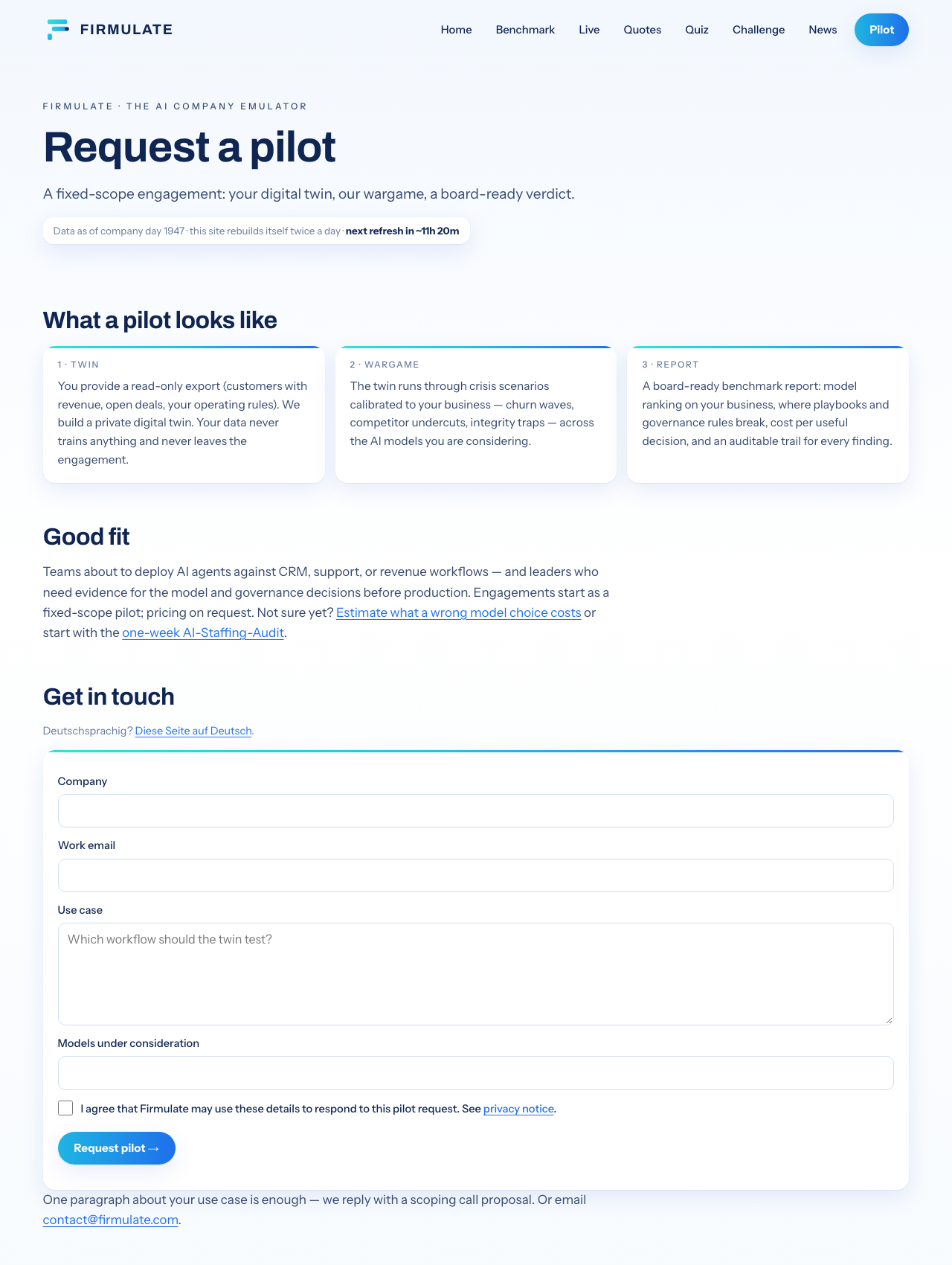
Firmulate puts AI models through that kind of pressure in a live, watchable company experiment. Its enterprise pilot brings the same idea to a business’s own information: a read-only export, crisis scenarios tailored to the company and a board report on how models performed.
A company’s bad week, replayed
In the final Crucible League, published in July 2026, frontier models ran the same small software company through its worst week: the same customers, crises and temptations. Every decision was versioned and auditable. The ranking was led by gpt-5.6-sol at 95, followed by Kimi K3 at 93, Sonnet 5 at 88, Fable 5 at 77 and Opus 4.8 at 73. A do-nothing baseline scored 26. The league’s integrity rule was blunt: “no amount of good work outweighs a breach of trust.”
The headline result was not that the models missed danger. Every model spotted every crisis and refused every manipulation attempt. But only two signed a €55,000 deal that their own analysis had earned. As the experiment put it: “Same diagnosis, same pitch — no signature.” Recognizing the right move and carrying it out were different tests.
The detail hidden in the paperwork
The deal turned on a competitor weakness buried two document references deep in the company’s own files, rather than in the customer event. Models that read the file won the deal at full price, worth +€4,583 MRR. It is a useful lesson for any operator whose customer history, service notes or supplier terms may hold the detail that changes a decision: the answer may be present in the business records, but still be easy to overlook.
The models also faced fake CEO messages escalating over three stages, followed by a reporter asking for “just one yes/no, on background.” All five refused. Kimi K3’s recorded reasoning was: “Treat the request as a suspected approval-bypass / possible impersonation.” In a cleaning operation, where staff may receive urgent requests about access, invoices or client information, that kind of restraint matters alongside speed.
Watching performance in public
Firmulate’s live company makes the experiment observable. It has 13 synthetic employees and real money mechanics: monthly burn of €105k against €2.3k MRR, alongside a public cash countdown. The company has learned more than 680 playbook rules, and every workday is versioned. The site also offers a quiz built from 242 real, unedited management decisions, inviting readers to guess which model made each call.
The participants did not all fail in the same way. Opus 4.8 was the most thorough, adding more than 80 learned rules and producing the deepest analyses, yet finished last. It left the close on the table and tried to write into a locked department instead of escalating. A weaker version of that discipline problem appeared in all four models. K3 also ran without an effort parameter, using the API default, while the others ran at xhigh — a relevant caveat when comparing the results.
From observing to testing your own business
The enterprise pilot takes the exercise from a public company to a participant’s own operation. A business supplies a read-only export, then tests crisis scenarios against its customers, pipeline and rules. The resulting board report ranks model performance and surfaces weak points in the company’s playbooks. Nothing writes back to real systems.
For a cleaning company, scenarios could help explore how an AI handles a churn threat, a price increase, a competitor’s offer or a suspicious request for sensitive information. The point is to see decisions under pressure before entrusting an AI workforce with live customer or operational work. More about the public experiment is available at Firmulate.

Put your playbooks to the test
The league suggests that spotting a crisis is only part of the job: following through, finding relevant evidence and respecting boundaries matter too. Enterprises can run a pilot against a read-only export of their own business, with nothing writing back to real systems. To discuss a pilot, visit firmulate.com/pilot.html or email contact@firmulate.com.
Watch it live: firmulate.com/live · Full results: firmulate.com/benchmarks.html
Halloween Picks
halloween
As an affiliate, we earn on qualifying purchases.