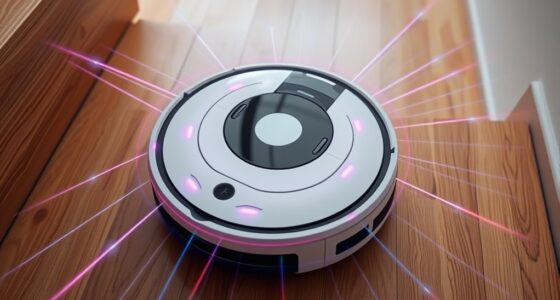
AI-powered object recognition helps robots identify and avoid cords, socks, and other household clutter. These advanced systems enable your robot to navigate safely, recognizing everyday objects in real-time, so it doesn’t get stuck or cause damage. As the technology improves, robots become more accurate and adaptable in cluttered environments. If you want to discover how this smart recognition works and the benefits it brings, there’s more to explore beneath the surface.
Key Takeaways
- AI object recognition enables robots to identify and classify household items like cords and socks in real-time.
- Advanced recognition allows robots to detect obstacles, preventing entanglement and accidents during navigation.
- Machine learning improves object detection accuracy over time, helping robots adapt to changing environments.
- Recognizing specific objects helps household robots plan safe routes and avoid common clutter.
- These capabilities contribute to smarter, more autonomous robots that efficiently handle household obstacles.
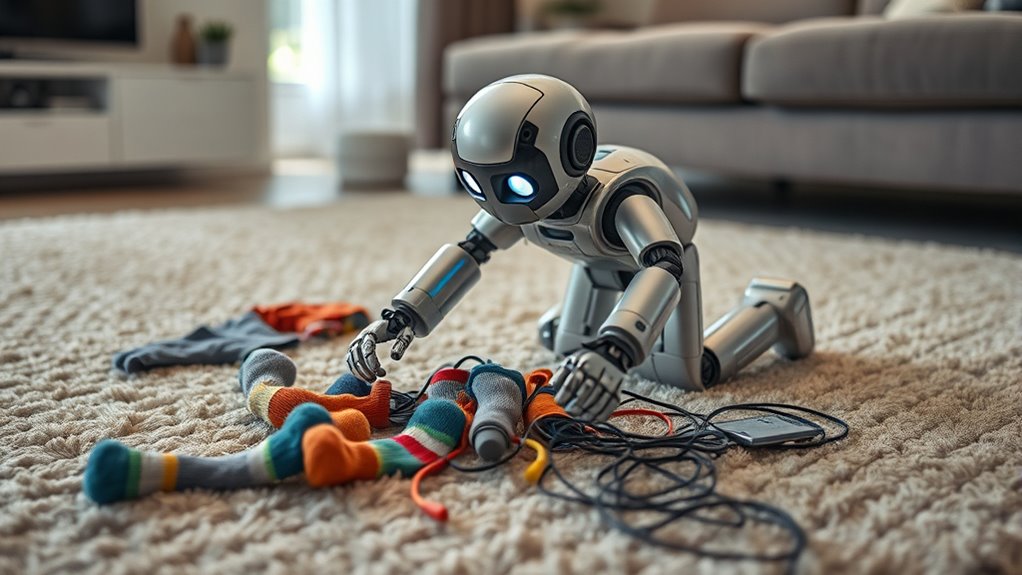
AI object recognition is a rapidly advancing field that enables machines to identify and categorize objects within images or videos with remarkable accuracy. As a result, robots become more adept at maneuvering complex environments, especially in household settings. When it comes to household automation, this technology allows robots to distinguish between everyday objects—like cords, socks, or furniture—and adapt their movements accordingly. You’ll notice that modern robots don’t just blindly move around; they actively analyze their surroundings, identify objects that could hinder their path, and plan a route around them. This ability enhances robot guidance by making it more precise and reliable. You don’t have to worry about your cluttered living room confusing your robotic helper anymore. Instead, it learns to interpret the scene, recognize the objects that matter, and adjust its course in real time. This not only improves the robot’s performance but also reduces the need for manual intervention.
AI object recognition helps robots navigate and adapt in household environments efficiently.
Imagine a robot vacuum that can recognize and steer clear of tangled cords or scattered socks on your floor. Thanks to AI object recognition, it doesn’t get stuck or cause damage. Instead, it surveys the environment, identifies objects that could hinder its path, and plans a route around them. This capability is made possible by machine learning, which enables robots to improve their recognition abilities over time through experience. This enhances robot guidance by making it more precise and reliable. You don’t have to worry about your cluttered living room confusing your robotic helper anymore. Instead, it learns to interpret the scene, recognize the objects that matter, and adjust its course in real time. This not only improves the robot’s performance but also reduces the need for manual intervention.
In household automation, AI-powered object recognition plays an essential role in creating smarter, more intuitive devices. For example, smart assistants equipped with cameras can recognize household objects, helping with inventory management or providing safety alerts if something is out of place. Robots can also identify specific items, such as a misplaced sock or a charging cable, and handle them appropriately—whether to pick them up, avoid them, or notify you. These capabilities make household automation more seamless, reducing everyday frustrations and freeing up your time.
The integration of AI object recognition into household robots transforms the way you interact with technology. Instead of robotic devices that follow rigid programming, you get adaptive systems that understand their environment and respond intelligently. They become more than just cleaning tools—they turn into intelligent helpers that can maneuver cluttered spaces, recognize objects, and perform tasks with minimal supervision. As this technology continues to evolve, expect your household robots to become even more perceptive and autonomous, making your daily routines smoother and more efficient. With AI object recognition, your home becomes a smarter, safer space where robots can truly assist you in maneuvering the chaos of daily life.
Frequently Asked Questions
How Do Robots Differentiate Between Similar-Looking Objects?
You can tell similar-looking objects apart by leveraging object feature extraction, which identifies unique characteristics like shape, color, and texture. Then, machine learning algorithms analyze these features to create a detailed profile for each object. By training on diverse data, the robot learns to distinguish even closely resembling items, improving accuracy over time. This combination helps your robot recognize and differentiate objects reliably in various environments.
Can AI Recognize Objects in Low-Light Conditions?
Think of AI as having night vision goggles—yes, it can recognize objects in low-light conditions. With advanced low light sensors, your robot sees through the darkness like a nocturnal predator. It uses infrared and thermal imaging to detect shapes and movement when the lights are out. So, even in dim environments, your robot can identify objects accurately, keeping it effective and safe in night-time or poorly lit spaces.
What Are the Limitations of Current Object Recognition Technology?
You should know that current object recognition technology faces sensor limitations, which can hinder accuracy in complex environments or poor lighting. Dataset biases also impact performance, causing the system to struggle with unfamiliar or diverse objects. These issues mean you might see errors or misidentifications, especially with rare items or in challenging conditions. Improving sensor quality and expanding diverse datasets are essential steps to enhance recognition capabilities.
How Do Robots Update Their Object Databases Over Time?
You update your robot’s object database through continuous learning, leveraging machine learning to improve data accuracy. By collecting new images and sensor data, the robot refines its recognition skills, adapting to changing environments and objects. Regular updates, whether through manual uploads or automated processes, help your robot recognize cords, socks, and more with greater precision, ensuring it stays smart, swift, and super-successful in its tasks.
Are There Privacy Concerns With AI Object Recognition in Homes?
Yes, there are privacy concerns with AI object recognition in homes. You might worry about privacy intrusion if your devices constantly monitor your activities. Data security becomes vital to protect your personal information from breaches. Make certain your smart devices have strong encryption and clear privacy policies. Being aware of what data is collected and how it’s used helps you maintain better control over your privacy and reduces potential risks.
Conclusion
Imagine a world where robots seamlessly navigate around cords and socks, like skilled dancers avoiding obstacles in a delicate ballet. Thanks to AI object recognition, this isn’t just a dream—it’s becoming reality. As technology advances, you’ll see robots becoming smarter, more intuitive, and better at understanding their surroundings. The future is a dance of innovation, where machines and humans move together in harmony—guided by the silent intelligence of AI.