
TL;DR

Get cleaning gear delivered free with Prime
- Fast, free delivery on millions of items
- Prime Video, Amazon Music and more included
- Member-only deals all year
Hunker has featured a DIY project that repurposes a Dollar Tree pool noodle into a vintage-inspired decorative vase. The tutorial uses a toilet paper tube and cardboard for structure, then covers the form with decoupage paper or paint; it is a craft project, not a functional water-holding vase.
Hunker has reported on a DIY project that turns a Dollar Tree pool noodle into a vintage-inspired decorative vase, using a toilet paper tube and cardboard to shape the form and decoupage napkins or paint for its finish. The project, demonstrated in a video by YouTube creator NamrataALLINONE, offers a way to reuse a noodle with supplies that may already be at home.
The basic materials listed are a pool noodle, an empty toilet paper tube, a small cardboard box, masking tape, glue and decorative paper napkins. The assembly also calls for a utility knife, hot glue gun, paintbrush, ruler and scissors. Hunker says the noodle’s original color does not matter because the exterior is covered during finishing. It reports that Dollar Tree sells pool noodles for $1 each; prices and availability may vary by store and date.
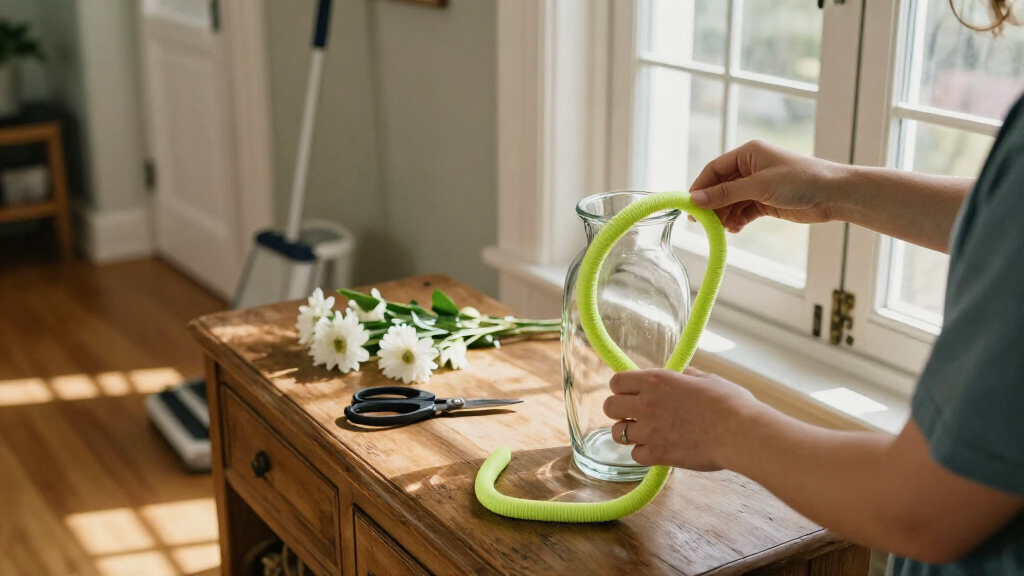
To form the vase, the maker cuts a wedge from each end of the noodle, lines the openings up and inserts the toilet paper tube to create the neck. Hot glue and masking tape hold the shape together. A second piece of noodle is cut to cover the exposed tube, and the bottom of the loop is attached to a cardboard box to make a base. The steps rely on cutting and hot glue, so care is needed when handling the utility knife and glue gun.
For the paper finish, the tutorial mixes two parts glue with one part water. It separates a napkin’s printed layer from its white backing, applies the backing strips first, then adds the patterned strips over the surface. Hunker suggests a vintage floral pattern for the intended look, while noting that other designs can be used. Painting is offered as an alternative; a textured spray paint may help obscure the noodle’s surface. The finished craft is described for artificial flowers or decorative stems, not as a watertight container.
A Low-Cost Reuse Craft
The project matters mainly as a low-cost, accessible craft idea rather than a major product or retail development. Its structure uses inexpensive and commonly discarded materials, while decoupage gives makers room to choose a pattern that suits their decor. Reusing an old or faded noodle can also give it a second use instead of sending it directly to waste.
There are practical limits: the form is made from foam, cardboard and paper, and the source does not describe waterproofing or testing it with real water. Treating it as a decorative sleeve for artificial arrangements is consistent with the instructions. Readers who want a vase for fresh flowers would need a separate watertight vessel inside it, and should not assume the DIY construction can hold water safely.
Products Worth Considering

Philips Hue Festavia 65-Foot Smart LED String Lights, 250 Color-Changing Mini LEDs

Dyson Omni-Glide Cordless Stick Vacuum, Gold/Iron

eufy Security SoloCam S340 3K Dual-Lens Solar Security Camera
As an affiliate, we earn on qualifying purchases.
How the Vase Takes Shape
The report frames the design as vintage-inspired, connecting floral napkins and decoupage with a decorative look associated in the article with 1980s floral decor. Decoupage involves layering paper onto a surface with adhesive. Here, it also conceals the bright or worn appearance of the noodle and helps make the finished object look less like its original material.
Hunker credits the step-by-step demonstration to NamrataALLINONE on YouTube. It also mentions a commercial pack of vintage floral napkins as one possible choice, but the project does not depend on that brand or a particular paper style. The source says it may receive commissions from purchases made through links, a disclosure relevant to its product recommendations.
““the materials list for this project is small and composed largely of things you may already have around the house.””
— Hunker
Limits of the DIY Instructions
The supplied report does not give a publication date, independent testing, or measurements for the finished vase. It also does not specify how long the glue mixture needs to dry, whether the object should receive a protective seal, or how well it will hold up to regular handling. The tutorial describes a decorative project, and water resistance is not established.
The $1 price is attributed to Hunker’s report and should not be read as a guarantee of current pricing or stock. The source does not provide a cost estimate for the complete project, which may depend on what tools and materials the maker already owns. No claim is made that the craft has been tested for durability or safety as a container.
Finishing and Displaying the Vase
After assembly and decoration, the maker should allow the glue and paper layers to dry fully before adding decorative stems. Hunker’s instructions suggest festive stems or artificial flowers for display. A maker choosing spray paint should follow the product label, use suitable ventilation and protect nearby surfaces.
The immediate next step for readers is to decide between decoupage and paint, then check that the required supplies are available before cutting the noodle. The source provides no announced follow-up, product test or update; whether the creator or Hunker will publish additional guidance is unknown.
Key Questions
Can the DIY vase hold water?
The instructions do not establish that it is watertight. It is described for artificial flowers or decorative stems; use a separate water-safe container if displaying fresh flowers.
What materials are needed?
The listed materials include a pool noodle, toilet paper tube, small cardboard box, masking tape, glue and paper napkins. Tools include a utility knife, hot glue gun, paintbrush, ruler and scissors.
How is the vintage floral finish made?
The tutorial uses decoupage: mix two parts glue and one part water, apply strips of a napkin’s white backing, then layer the printed paper over the form. The source also gives painting as an alternative.
Does the pool noodle need to be new?
No. Hunker says the noodle’s color is covered by the finish, so an old or faded one can be used if it remains suitable for shaping.
How much does the project cost?
Hunker reports that a Dollar Tree pool noodle costs $1, but that figure is not a complete project budget. Prices and availability may change, and the source does not total the cost of other supplies.
Source: hunker.com